
African Wild Dogs: The Painted Wolves of the Savannah Who Live and Hunt as One
In the golden glow of early dawn, a ripple of energy stirs across the African plains. Moving like shadows, lean bodies painted in streaks of gold, white, and black emerge from the underbrush. They are not lions, nor hyenas, nor jackals—but a different kind of predator entirely. With oversized ears, expressive eyes, and an unmatched sense of teamwork, African wild dogs—also called painted wolves—are among the most remarkable carnivores on Earth. Their presence is a symphony of strategy, speed, and loyalty, written across vast wildernesses and etched into the rhythms of the African wild.
African wild dogs (Lycaon pictus), though less well-known than their feline or canine counterparts, represent one of nature’s most fascinating and endangered social hunters. Once found throughout much of sub-Saharan Africa, these pack-dwelling animals are now confined to scattered pockets across the continent, battling habitat loss, human conflict, and disease. Yet those who study and observe them agree: few creatures embody the spirit of cooperation, coordination, and community quite like the African wild dog. To explore their world is to unlock a deeper understanding of the wild’s delicate choreography—where survival depends not just on strength or cunning, but on unity.
A: Start with body shape and habitat, then use color, markings, size, and behavior as confirmation.
A: Because African Wild Dogs has its own mix of structure, habitat, feeding, and comparison clues.
A: Compare it with the nearest parent, child, or lookalike pages before treating one trait as final.
A: No. Age, season, lighting, region, and posture can all change the first impression.
A: Look for the setting that explains the animal: water, cover, vegetation, substrate, altitude, reef, burrow, branch, or open ground.
A: The exact diet depends on the animal, but mouth shape, movement, and habitat usually reveal the feeding strategy.
A: Many animals change size, color, pattern, diet, risk, or habitat between young and adult stages.
A: Use the photo to check eye position, body outline, limbs or fins, texture, posture, and surrounding habitat.
A: Yes. Every animal affects food webs, habitat structure, competition, nutrient movement, or predator-prey balance in some way.
A: It should connect the animal's visible traits to how it survives, moves, feeds, and fits the taxonomy.
East African Painted Dog
East African Painted Dog: The Wild Spirit of the Savanna Scientific Name: Lycaon pictus In the heart of East Africa’s golden savannas and rugged woodlands roams one of the continent’s most charismatic and misunderstood predators—the East African Painted Dog (Lycaon pictus). Known for its striking coat, tireless endurance, and intricate pack dynamics, this animal is not only a symbol of wild Africa but also a vital thread in the fabric
Southern African Painted Dog
The Southern African Painted Dog: Nature’s Wild Masterpiece In the sun-drenched savannas and mopane woodlands of Southern Africa roams one of the continent’s most enigmatic and misunderstood predators: the Southern African Painted Dog (Lycaon pictus pictus). Often referred to as the African wild dog, Cape hunting dog, or simply painted wolf, this subspecies is a spectacle of nature’s design—both in its social complexity and its physical appearance. With their blotchy,
The Essence of the Pack: Biology and Social Behavior of African Wild Dogs
African wild dogs are medium-sized canids, weighing between 40 and 80 pounds, with long limbs built for endurance running. Their fur is short and coarse, uniquely patterned with splotches of black, brown, yellow, and white. No two individuals share the same coat—each one is a living canvas of wild artistry, giving rise to their nickname “painted wolves.” Their ears are large and rounded, acting as directional sensors that help with thermoregulation and long-distance communication.
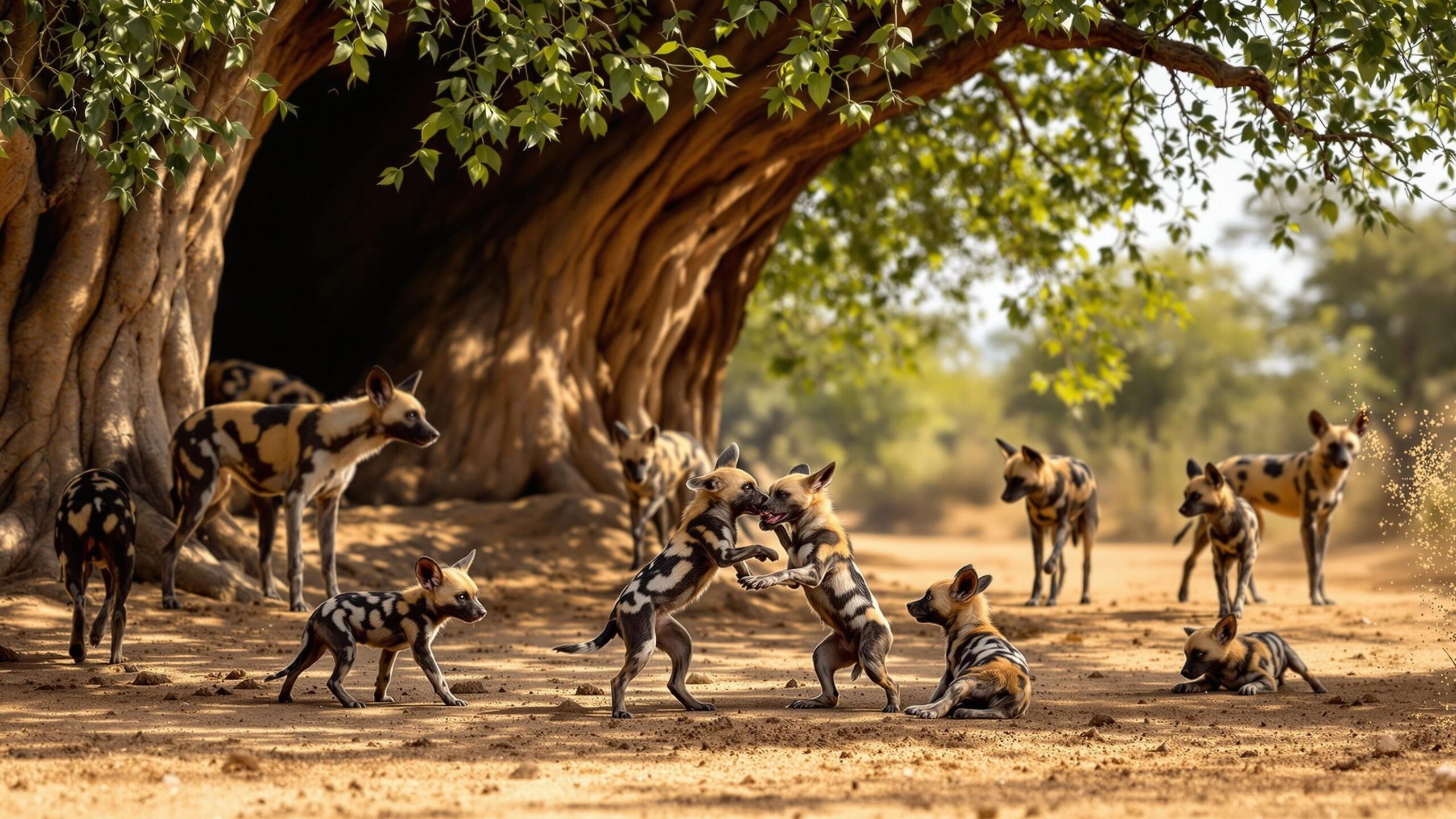
What truly sets African wild dogs apart is their social structure. They live and hunt in cohesive packs, typically ranging from 6 to 20 individuals, although packs of up to 40 have been recorded. These packs operate under a dominant breeding pair—the alpha male and alpha female—while all other adults contribute to the rearing of pups and the collective care of the group. Their cooperative behavior extends to every part of life: pack members share food after hunts, care for injured or ill companions, and take turns guarding pups at the den. Their complex vocal repertoire includes high-pitched twitters, yips, and rallying calls that help them coordinate movement and maintain pack unity. Their commitment to one another forms the backbone of their identity—and their survival.
The Art of the Hunt: Strategy, Speed, and Success
In a land filled with powerful predators, African wild dogs have earned their place through extraordinary hunting skill. Their hunts are not ambushes like those of lions, nor opportunistic scavenges like hyenas. Instead, wild dogs are endurance hunters. They rely on relentless speed and coordination to exhaust and isolate their prey. A hunt begins with a silent signal—often a touch, a look, or a sound—that cues the pack into action. As they spread out in formation, each dog plays a role, anticipating turns, covering escape routes, and closing in from multiple angles. Their preferred prey includes impala, gazelles, and wildebeest calves, but they’ve been known to take down much larger animals when conditions allow. Success rates for African wild dog hunts are among the highest of any large predator, with some studies reporting up to 80% efficiency. Once prey is brought down, a rapid, almost frenzied feeding takes place, with the entire pack—young and old—joining in. Unlike many predators, the young are allowed to feed first, another reflection of the pack’s communal ethic.
Regional Variations: Packs Across the African Landscape
African wild dogs are found in a variety of ecosystems, from the open plains of the Serengeti to the dense woodlands of Zimbabwe and the floodplains of the Okavango Delta. These regional differences shape their behavior, pack dynamics, and hunting strategies. In the Okavango Delta of Botswana, where channels and wetlands break up the terrain, wild dogs must adapt their chases to a watery world. Here, hunts are often shorter and more explosive, taking place in bursts between islands of dry land. The Delta also offers some of the most stable populations of wild dogs, supported by robust conservation policies and limited human interference.
In Kruger National Park in South Africa, wild dogs live in landscapes that vary from bushveld to open grasslands. These packs must contend with high densities of competing predators like lions and hyenas, which frequently steal kills or attack pups. As a result, Kruger wild dogs tend to hunt at dawn and dusk, when lions are less active, and use speed to escape confrontation. In Tanzania’s Selous Game Reserve, one of the last strongholds for East African wild dogs, larger home ranges and sparse prey demand even more cooperation and distance-traveling behavior. These dogs may cover over 30 kilometers in a single day, weaving through miombo woodlands in pursuit of sustenance and safety.
The Life Cycle of the Pack: Reproduction and Pup Rearing
Each year, typically during the dry season when prey is more concentrated, a dominant female will give birth to a litter of 6 to 16 pups—the largest average litter of any canid species. The birth takes place in a secure den, often a repurposed aardvark burrow or sheltered thicket. The entire pack becomes dedicated to protecting and provisioning the pups. For the first several weeks, pups remain hidden, nursing and growing under the care of their mother and older siblings. During this time, adult pack members regurgitate food to feed both the nursing mother and the emerging pups.
This selfless behavior ensures that all members of the pack contribute to the next generation’s survival. As the pups grow and begin exploring, they are gradually introduced to hunts and taught social behaviors. Games of chase, tug-of-war, and mock battles build motor skills and establish relationships within the future hierarchy. By 12 to 14 months, the young are fully integrated into the pack and may participate in hunts. Around 2 to 3 years of age, some individuals will disperse—usually in same-sex groups—to find mates and start new packs. This dispersal prevents inbreeding and promotes genetic diversity, a vital adaptation for a species with relatively low global numbers.
Communication and Coordination: How Painted Wolves Stay in Sync
African wild dogs possess a remarkable system of communication that allows them to function with almost supernatural cohesion. In addition to their audible calls, they use body language, tail positioning, scent marking, and facial expressions to convey intentions and emotions. One of the most fascinating discoveries in recent years is the “sneeze” as a democratic rallying signal. Before a hunt, wild dogs will often gather in what appears to be a disorganized group.
They greet one another with excited twitters and high-energy body language. Then, they begin to sneeze. Scientists have found that when more dogs sneeze in a short time—especially high-ranking individuals—the pack is more likely to initiate a hunt. This quorum-like behavior illustrates a form of consensus decision-making rare in the animal kingdom. Such intricate communication systems help prevent conflict within the pack and ensure that every move, every hunt, and every escape operates with synchronized precision.
Enemies of the Pack: Challenges from Predators and People
Despite their impressive skills and social intelligence, African wild dogs face significant threats in the wild. Lions are their most dangerous natural predators, known to kill wild dogs and destroy pups without even consuming them. This hostility may stem from competition for prey and territory. Hyenas, too, are frequent adversaries, harassing wild dogs during hunts and stealing carcasses through sheer numbers and aggression.
Human-related threats, however, are even more serious. Habitat loss from agriculture, infrastructure, and expanding settlements fragments the wide-ranging territories wild dogs need to thrive. Roads and fences disrupt movement, and roadkill is a leading cause of death in some populations. Domestic dogs introduce diseases like rabies and canine distemper, both of which can decimate entire packs within weeks. Historically, wild dogs have been persecuted as livestock killers and pests, despite minimal evidence supporting such claims. Their painted coats and eerie calls led to unfounded fears and widespread culling. Today, while attitudes are shifting, outdated myths still linger in many regions.
Conservation in Motion: Saving the Painted Wolf
African wild dogs are classified as Endangered by the IUCN, with an estimated population of fewer than 7,000 individuals in the wild—and only about 1,400 mature breeding adults. Conservation efforts are both urgent and dynamic, involving a blend of field science, community outreach, and habitat protection. One of the most successful models is the use of wildlife corridors—natural pathways that connect isolated reserves and allow wild dog packs to travel safely in search of food and mates. Projects in Botswana and Zambia have demonstrated the power of such connectivity in sustaining viable populations. Vaccination programs targeting domestic dogs near reserves help prevent disease transmission, while education campaigns teach local communities about the ecological benefits of wild dogs, such as their role in controlling herbivore populations and scavenging carcasses that could otherwise spread disease. Wildlife tourism also plays a role. Packs that range near high-end eco-lodges generate income for conservation and incentivize local stakeholders to protect rather than persecute them. Researchers use GPS collars, camera traps, and aerial surveys to monitor populations and study movement, leading to better-informed policies and protections.
The Painted Wolf in Culture: Symbolism and Storytelling
In many African cultures, the wild dog is an elusive and revered figure. Its teamwork, loyalty, and success against odds have inspired both fear and admiration. In Shona and Zulu traditions, the wild dog is respected for its hunting prowess and family devotion. Stories of painted wolves working together to overcome challenges echo in the oral traditions of tribes across southern Africa. In modern conservation circles, African wild dogs are becoming charismatic ambassadors for broader biodiversity initiatives. Their stories—a blend of hardship, heroism, and hope—resonate with audiences around the world. Documentaries like Dynasties and The Hunt have introduced the painted wolf to millions, highlighting their beauty and vulnerability. The more we tell their stories, the more the world begins to understand the power of the pack—not just in the wild, but as a metaphor for our own role in the natural world.
The Future Runs with the Pack
African wild dogs are more than predators. They are mentors, providers, protectors, and pathfinders. They are the architects of cooperation in a world that often rewards the individual. Their survival speaks to the possibility that success in nature—and perhaps in life—is rooted not just in instinct, but in compassion, coordination, and community. As we navigate a future filled with environmental uncertainty, the painted wolves offer a lesson in resilience and unity. Every pack that races across the savanna, every pup that tumbles in the dust, every howl that carries on the evening wind is a call—a call to protect what is wild, connected, and irreplaceable. Let that call guide you further. Explore the stories of different regional packs. Discover how wild dogs navigate a changing Africa. Learn how you can support their survival. The future of the painted wolf is still unwritten, and every voice, every action, and every understanding adds to the chorus.
Animal Product Reviews
Dive into Animal Streets’ Animal Product Reviews — your guide to the best gear, gifts, books, and gadgets inspired by the animal kingdom. From land-roaming lions to ocean-gliding whales, from household pets to prehistoric giants, we explore top-rated products for enthusiasts, educators, and animal lovers alike. Whether you’re shopping for toys, decor, field gear, or fun collectibles, we’ve sniffed out the best so you can discover it all in one wild place!