
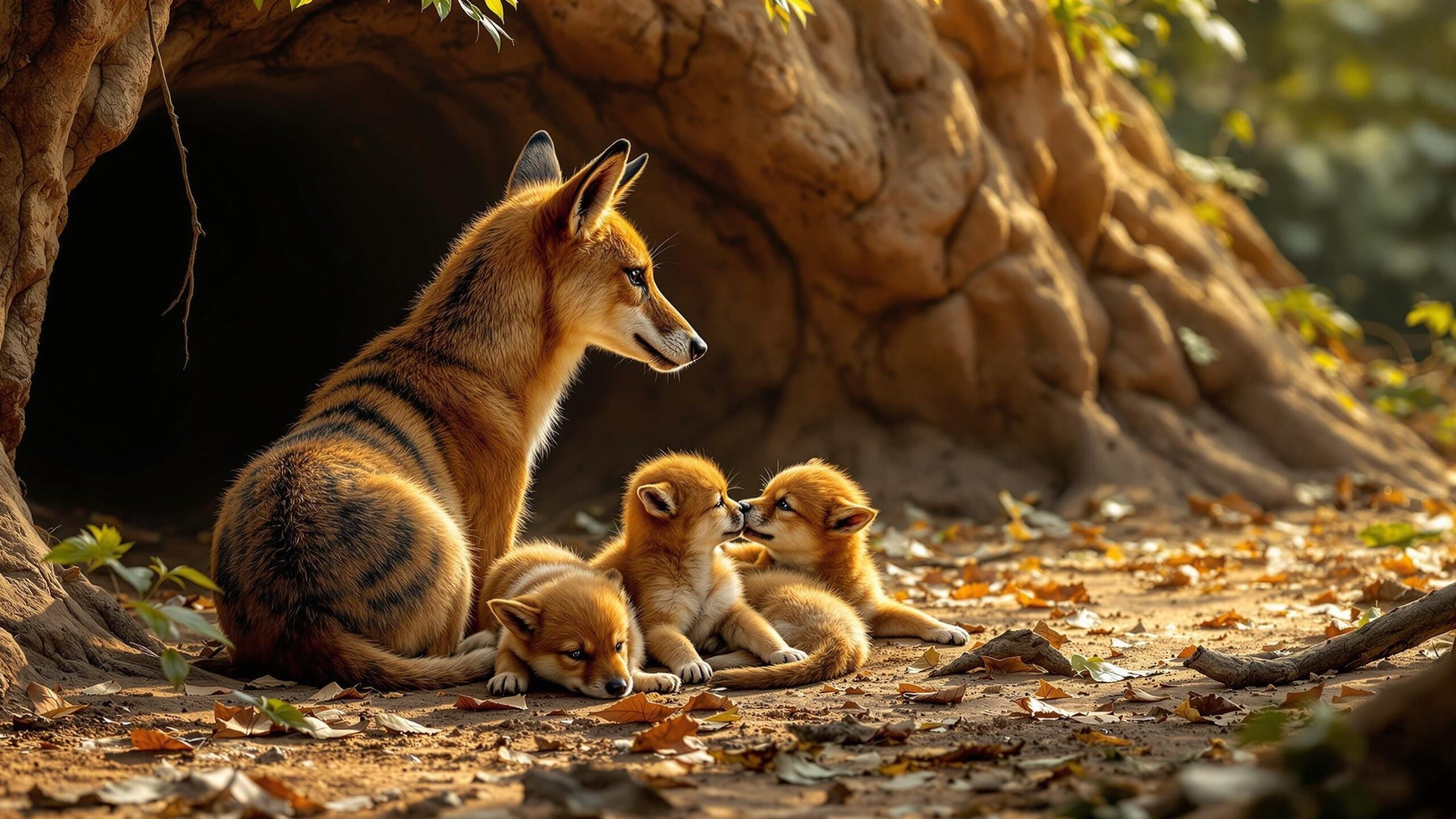
The dhole (Cuon alpinus) is an Asian wild canid whose social life joins cooperative hunting with shared care of pups. Its piercing contact calls have earned it the name whistling dog. Across fragmented forests and mountain landscapes, this endangered carnivore follows a varied prey base, from small deer to larger ungulates.
Natural history: A meat-eating Asian canid, the dhole occupies habitats ranging from deciduous woodland to montane forest. Groups cooperate in obtaining food and delivering it to dependent young. Individual hunting also occurs.
Life cycle: Pregnancy lasts about two months. Pups receive milk and regurgitated food, then gradually accompany adults and acquire hunting skills. Helpers contribute to feeding and protection.
Classification: Animalia; Chordata; Mammalia; Carnivora; Canidae; Cuon alpinus (Pallas, 1811).
Cuon has one living species. Regional Indian and Southeast Asian dholes belong to it; the genetic divisions studied so far cross regional boundaries and do not settle traditional subspecies limits.
Dhole communication combines sound with bodily scent-marking displays. Their voices can contain two independent frequencies at once, and detailed recordings reveal individual acoustic signatures. A pack’s social exchanges also include mutual grooming and play, while food sharing extends cooperation from the hunting group to animals attending pups.
Do dholes always hunt in packs?
No. They also forage alone or in pairs, especially for small prey.
Are Indian and Southeast Asian dholes different species?
Both are Cuon alpinus. Regional names describe populations, not separate species.
Why are they called whistling dogs?
Their high-pitched contact calls can sound like whistles and accompany regrouping.
How long can a dhole live?
The documented captive maximum is 16.1 years. Average longevity in the wild remains uncertain.
What threatens them?
Major pressures include declining prey, fragmented habitat, persecution, snares and infections from domestic dogs.

Indian Dhole
Indian dholes are populations of Cuon alpinus, a social Asian canid found in varied Indian landscapes. Cooperative hunting and food sharing link mobile adults with dependent pups. Regional studies reveal strong reliance on wild prey and show why habitat connections matter for this Endangered species.

Southeast Asian Dhole
Southeast Asian Dhole gives readers a focused look at identification, ecology, behavior, habitat, and comparison points within the wider dholes group.
Recognizing a dhole
A broad, short muzzle and upright ears with rounded tips give the dhole a distinctive face. Adults commonly have rusty or reddish-brown fur, a pale throat and underside, and a long, brushy tail that darkens toward black. The combination of face, ears and tail is more useful for recognition than coat color by itself. Some animals are noticeably browner or greyer than others.
Adult females commonly weigh around 10–13 kg, while males are usually heavier at about 15–20 kg. Both sexes share the same general coloration. Approximate species-account dimensions put head-and-body length near 90 cm, the separate tail at 40–45 cm and shoulder height around 50 cm. Head-and-body length excludes the tail.
Age and geography change the appearance. Pups begin life in dark, sooty-brown fur and develop a more adult reddish coat at approximately three months. Northern and high-elevation animals tend to grow longer, denser pelage than southern dholes.
Golden jackals generally have a narrower face, more pointed ears, a grizzled yellow-brown coat and a proportionally shorter tail. Grey wolves are generally larger and longer-muzzled, with pointed ears. Golden jackals also use grasslands, wetlands and human-modified habitats as well as forests. Dholes in the Indian and Southeast Asian feeding studies inhabited forests and woodlands supporting wild ungulates. Wolves have a much wider northern distribution than the dhole’s principal surviving strongholds.
Teeth built for a meat-rich diet
The adult dhole normally has 40 teeth. It lacks the third lower molar on each side that occurs in the usual Canis arrangement, accounting for the difference of two teeth. Behind the cutting teeth, its grinding surfaces are reduced. The lower carnassial, a major flesh-slicing tooth, has a simplified rear portion with one principal cusp.
This emphasis on cutting suits a diet dominated by animal tissue. The skull is relatively broad, with a convex profile, while the lower jaw is short and the premolars pointed. These skeletal characters distinguish Cuon more precisely than reddish fur does.
One species across several regions
Cuon alpinus is the only living species in its genus, within the dog family Canidae. Indian wild dog, Asiatic wild dog and red dog are names for this same animal. Indian and Southeast Asian populations occupy different ecological settings, but those regional labels do not designate separate species.
A 2005 genetic study found two broad mainland groupings. One extended from India south of the Ganges into Myanmar; the other ran from north of the Ganges through northeastern India and Myanmar to Thailand and Peninsular Malaysia. The researchers combined mitochondrial and microsatellite evidence from wild faecal samples, museum specimens and captive animals. Differentiation broadly increased with geographic distance, and the results did not clearly match traditional subspecies divisions based on coats. Subspecies boundaries remain unsettled, as do the origins and relationships of the populations on Sumatra and Java.
Surviving range and northern records
Major Indian populations survive in the Western Ghats, central Indian forests and northeastern landscapes. Elsewhere, the fragmented range includes Nepal, Bhutan, Bangladesh, China, Myanmar, Thailand, Laos, Cambodia, Malaysia and Indonesia. Occupied habitat within these countries is much more restricted than their borders suggest. Sumatra and Java both support wild populations.
The historical range reached southern Russia, including the Amur and Baikal regions, and extended through the Altai, Tian Shan and Pamir mountains. Pallas originally described the animal as Canis alpinus from the Amur region. The 2015 conservation assessment estimated that dholes had disappeared from more than three-quarters of their historical range, with extensive losses in the north.
Occasional discoveries still illuminate that northern margin. A scat collected near Ters-Agar Pass in southern Kyrgyzstan on 15 August 2019, at 3,603 m elevation, yielded a mitochondrial sequence identified as dhole during analysis in 2021. Published in 2022, the record came from opportunistic carnivore-scat surveys in the Bek-Tosot community conservancy, in alpine country near Tajikistan. It could represent an overlooked population or a dispersing individual.
In north-central Vietnam, a camera photographed a dhole in Pu Hoat Nature Reserve on 31 December 2023. The location was wet evergreen forest at 1,590 m, about 4.3 km from Laos. During November 2023–March 2024, the survey deployed 45 paired-camera stations and retrieved 37 after eight were lost or stolen, accumulating 6,084 camera-trap nights. Four biologists familiar with dholes independently supported the identification. The photograph establishes recent occurrence, while the animal’s membership in a resident group remains unresolved.
Forests, mountains and plantation mosaics
Dholes use forests, grasslands, shrublands and rocky landscapes, spanning warm lowlands and cold mountain country. Prey, shelter and breeding sites influence where packs can persist within that environmental breadth. In Maharashtra, studied populations inhabit tropical dry and moist deciduous forests in reserves surrounded by substantial human land use.
Southeast Asian sites reveal considerable habitat variety. Nam Et–Phou Louey in northern Laos is hilly and predominantly forested, grading from mixed evergreen-deciduous vegetation to evergreen montane forest. Srepok Wildlife Sanctuary in eastern Cambodia is flatter, with seasonally dry deciduous dipterocarp woodland, riparian forest and denser patches.
Baluran National Park in East Java combines savannah, deciduous woodland, evergreen forest and mountain rainforest. Seasonal drying concentrates water at springs and maintained waterholes. In India’s Western Ghats, Valparai dholes use tea and other plantations interspersed with rainforest fragments. Researchers there found greater use of flatter places away from settlements and areas with fragmented tree cover, including rainforest patches and eucalyptus stands. Resting and refuge sites combined dense vegetation with open sightlines, providing concealment while allowing animals to see their surroundings.
What wild dholes eat
Deer are prominent prey, but local diets differ. A 2022 study analyzed 861 scats from six Maharashtra protected areas. Sambar accounted for 61.08% of estimated prey biomass and chital for 19.08%. These estimates describe the modeled amount of food consumed, calculated from remains in scats and correction equations. Larger prey can contribute substantial biomass even when smaller prey are encountered more frequently.
The same project documented 191 kills separately: 160 in Tadoba-Andhari and 31 in Nawegaon-Nagzira. Chital outnumbered sambar among those observed kills. Other food remains included barking deer, four-horned antelope, gaur, nilgai, wild pigs, langurs, black-naped hares and rodents. The prey spectrum includes small mammals as well as calves or other vulnerable individuals of much larger species.
A Laos–Cambodia study analyzed 165 scats from each site. In Laos, muntjac contributed approximately 49% of estimated consumed biomass and sambar 23%. In Cambodia, muntjac supplied 45%, wild pig 28% and banteng 19%. Muntjac was selected relative to its availability at both sites. Selection compares consumption with the prey community available to the predator: an animal can be important because hunters take it disproportionately often, as well as because it supplies a large amount of food.
A 2014 synthesis found a significant preference for sambar across its pooled studies, which were predominantly Indian. Sambar, chital and wild boar supplied much of the pooled food biomass. These hoofed mammals link dhole feeding to the same prey communities used by Asia’s larger cats. Grass and bamboo leaves also appeared frequently in Maharashtra scats. Their ingestion is established, but proposed digestive or excretory functions remain hypotheses.
Chasing, intercepting and sharing food
Cooperative hunts can involve pursuit and interception. Accounts describe dholes driving moving prey toward waiting companions and following deer into water, where the prey’s movement can become constrained. Several hunters can then approach together. Lone animals and pairs also take small prey, including hares and infant deer. Hunting parties of fewer than ten are common, although occasional gatherings exceed thirty.
Two Mudumalai packs followed during 1989–1993 killed chital and sambar fawns more often than expected from their availability. In those packs, individual meat intake declined as pack size increased, and prey body mass did not rise with pack size. A broader dietary synthesis did find larger prey taken by larger packs across its combined dataset. In the pooled analysis, pack size did not explain the prey-preference index. The ability to capture a larger animal and a disproportionate tendency to select that animal were separate outcomes.
Food also travels beyond the kill. Hunters swallow meat and later regurgitate portions for nursing females, pups and helpers at dens. Carrying food internally supplies animals that remain with dependent young. This connection between hunting and pup care allows adults at the den to guard and tend the litter while other pack members forage.
Living in a changing pack
Joint travel and feeding are accompanied by play fighting, rolling and mutual grooming. Packs include breeding animals and subordinate helpers, with everyday affiliative exchanges more frequent than seriously damaging aggression. Their membership changes through births, dispersal and breeding failures. The two Mudumalai packs varied between 4–18 and 4–25 members over the study, giving each social unit a changing size and age structure.
Repeated sightings gave minimum home-range estimates of 83.3 km² and 54.2 km² for those packs. A different pack studied in Bandipur from August 1976 to July 1978 used approximately 40 km². Its mean count was 8.3 adults, rising to 16 when pups were included. The Mudumalai ranges were calculated from locations obtained through sightings, using minimum convex polygons around observations. Packs moved among patches offering prey and resting places, and the observed range areas did not simply increase with pack size.
Denning changed the Bandipur pack’s movements. Its hunting area was about 11 km² during that period, compared with more than 15 km² at other times. Young pups tied care to a fixed shelter while adults continued finding prey nearby. Movement between groups also varies locally: genetic work found stronger support for female-biased dispersal in Tadoba-Andhari than in Nawegaon-Nagzira.
Daily activity, scent and calls
Camera traps at Baluran during 2015–2020 recorded packs mainly around dawn and dusk. Animals photographed alone or in pairs showed a different schedule, with relatively greater late-night activity. These small photographed groupings could include temporarily separated pack members. In central India, behavioral observations also documented scent marking through distinctive hind-bounce and hind-scrub movements, alongside resting, locomotion, feeding and social exchanges.
Whistle-like contact calls occur as separated pack members regroup. Dholes also mew, whine, growl and give alarm-like sounds. Acoustic studies distinguish low-frequency yaps, high-frequency squeaks and combined yap-squeaks. The combined calls are biphonic: two independent fundamental frequencies occur simultaneously, adding complexity to one animal’s signal.
Video observations of captive dholes showed squeaks produced with the mouth closed and yaps with it open. A 2016 study linked recordings from four adults with postmortem examination of their vocal anatomy. All produced high-frequency and biphonic sounds, yet their vocal folds lacked the thin membranes proposed as a possible source. The mechanism producing the high frequencies remains unresolved.
Another study analyzed 450 calls from five captive subadults. Statistical classification assigned 96.7% of biphonic yap-squeaks to the predicted caller, compared with 80.7% of squeaks and 44.7% of yaps. The richer signals contained especially useful individual acoustic cues; whether listening dholes recognize those cues requires separate behavioral evidence.
Breeding and the work of raising pups
Female dholes usually have six or seven pairs of mammae, providing nursing sites for substantial litters. Gestation lasts roughly two months, commonly 60–63 days. Field observations include litters of five to ten pups in one Mudumalai pack and twelve associated with one lactating female in Kanha. The AnAge life-history compilation gives an average litter size of five and one litter per year. Those broad summaries sit alongside field records of larger litters and years without breeding in monitored packs.
Dens include earthen burrows and rocky caverns. In the Bandipur study, the pack occupied preexisting shelters. Adults helped guard, groom, feed and play with pups while the mother supplied milk. Specialist accounts describe regurgitated meat reaching pups from around three weeks, so milk and solid food overlap during early development. Captive newborns have been reported at approximately 200–350 g. The AnAge compilation places weaning at about 58 days. Provisioning with meat begins well before that compiled weaning age, allowing a gradual change in food while pups still depend on adults to obtain it.
Bandipur pups left their den at about 70–80 days old and actively participated in killing prey at approximately seven months. Traveling with adults and helping capture prey are different developmental achievements. Early feeding by helpers supports youngsters through the interval when their own hunting abilities are still developing.
Captive observations add detail about courtship. A study at Arignar Anna Zoological Park followed three wild-caught and two captive-born dholes over four mating seasons. Researchers recorded urine marking, vocal exchanges and investigation of scent marks. Mating included a copulatory tie and back-to-back posture. One captive-born pair showed sexual activity at eleven months; that observation establishes behavior rather than the age of first successful reproduction.
A twelve-month hormone study followed eight dholes in two Chiang Mai zoos: five males and three females, housed as three pairs and two bachelor males. Researchers tracked faecal hormone metabolites alongside behavior to relate reproductive changes to mating and birth. Two females imported from the Netherlands had reproductive hormone peaks in January and gave birth near the end of March and beginning of April. A locally born female cycled twice and mated without producing pups.
The longest captive lifespan recorded in the AnAge compilation is 16.1 years. Older wild dholes have disappeared from studied packs around seven to eight years of age, but disappearance can include dispersal as well as death. A reliable average wild lifespan is not established by those observations.
Sharing prey with larger carnivores
Dholes, tigers and leopards draw heavily on overlapping ungulate prey. Competition can involve the carcass itself: Maharashtra researchers recorded tigers taking dhole kills and dholes taking leopard kills. Tigers and leopards can also kill or eat dholes, placing the smaller pack hunter in both predator and prey roles.
At Baluran, camera-based daily activity overlap was 0.90 between dholes and muntjac and 0.70 between dholes and Javan leopards. These coefficients describe how closely activity schedules coincided. Diet records also include dhole hair in leopard scats, evidence that the interactions sometimes end with the pack hunter being eaten.
Dholes among people
In Laos, cattle and goat remains contributed a small share of estimated dietary biomass overall, with livestock consumption increasing in the hot-dry season. Grazing inside parts of the protected landscape brought domestic animals into hunting habitat. At Valparai, wild ungulates dominated faecal analyses, while cameras documented dholes scavenging discarded chicken at waste sites.
Valparai interviews revealed curiosity, admiration, caution and fear. Some residents used the respectful name Vettaikara Apichi, associated with hunting deities. The first interviews took place in March–May 2024 with 86 deliberately selected respondents; one reported livestock killed by dholes. None reported personally observing a dhole injuring a human, though two repeated a secondhand story. These local accounts describe experiences and beliefs rather than measured encounter rates.
Conservation of a fragmented hunter
The IUCN assessment dated 7 May 2015 classified the dhole as Endangered, with a decreasing population trend. Its uncertain estimate of 4,500–10,500 animals included 949–2,215 mature individuals. Those figures relied partly on assumptions about breeding within packs and are historical estimates, not a current worldwide census.
Prey depletion, habitat loss and fragmentation, persecution linked to livestock losses, and disease transmission from domestic dogs threaten surviving populations. Snares can capture dholes directly while also removing their prey. In Vietnam, 49 other large-scale camera surveys during 2014–2024 covered 31 sites and 269,524 camera-trap nights without detecting the species, underscoring its severe rarity beyond the Pu Hoat record.
Nepal’s 2025–2035 Dhole Conservation Action Plan links distribution surveys with prey protection, anti-poaching work, habitat management and public awareness. It prioritizes connected subpopulations, corridors and safeguards around linear infrastructure. Disease research and coordination with veterinary and public-health agencies address rabies and other pathogens. Its prey-monitoring and anti-poaching measures extend to protected and unprotected land. Connecting usable patches offers dispersing animals routes between subpopulations, while maintaining prey addresses a different constraint within occupied habitat. Forest cover alone cannot sustain a hunting pack if its food base has been depleted.
Animal Product Reviews
Dive into Animal Streets’ Animal Product Reviews — your guide to the best gear, gifts, books, and gadgets inspired by the animal kingdom. From land-roaming lions to ocean-gliding whales, from household pets to prehistoric giants, we explore top-rated products for enthusiasts, educators, families, and curious animal lovers.