
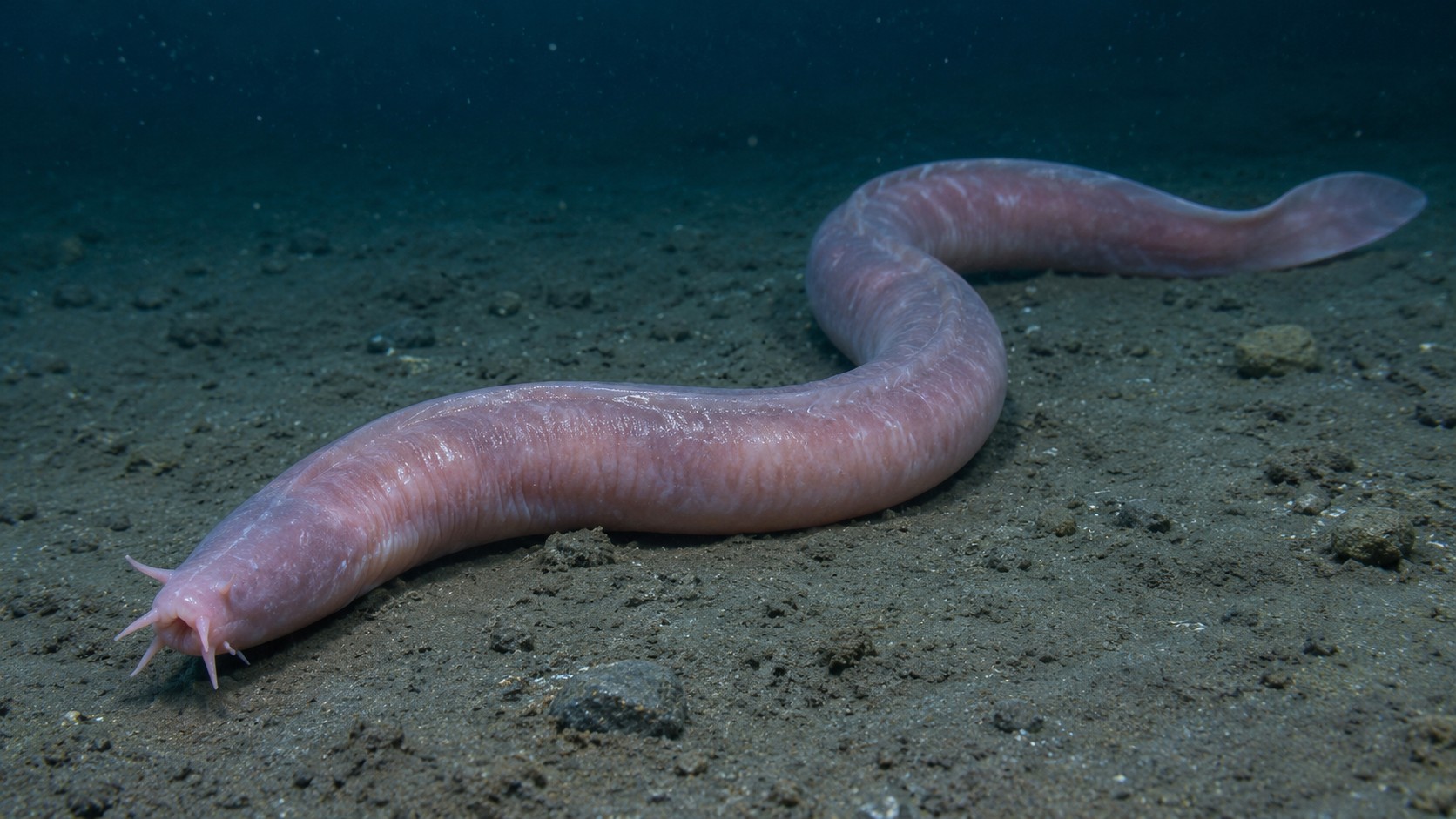
Reading a Fish Through Slime, Knots, and Sediment
A hagfish nosing across the seabed may look like a simple length of soft skin until it begins to move, feed, or defend itself. Sensory barbels explore the surroundings, specialized tooth plates take the place of hinged jaws, and a flexible body can form a traveling knot. When attacked, glands along its sides release the ingredients of a watery, thread-supported slime that can interrupt a predator’s attempt to swallow it. These marine jawless fishes belong to an ancient lineage, but they are living specialists rather than unchanged relics. Their story connects the physical properties of seawater with the practical demands of finding food and surviving on the ocean floor.
A: No. Concentrated gland secretions deploy into a watery mixture after release.
A: Mucus components and protein threads contribute to its structure.
A: Its retractile feeding apparatus uses horny tooth plates to grip and work food.
A: The body can brace against itself to provide purchase during pulling.
A: Knotting and body movement can help clear material away from the animal.
A: No. Living worms and other bottom organisms can also be important foods.
A: No. Some predators still consume hagfish.
A: It is commonly used for hagfish, which are a separate jawless group.
A: No. Habitat preferences and ranges vary among species.
A: Managers need to understand replacement and productivity, not just how many animals enter baited gear.
Atlantic Hagfish
The Atlantic hagfish is a jawless fish associated with muddy European seabeds. Its smooth, slender body ends in a continuous tail finfold, while barbels fringe the mouth and nasal region. The British account reports lengths reaching about 80 centimetres.
Hagfish Is a Group, Not One Global Species
The name hagfish covers a collection of marine species, including familiar representatives from the Atlantic and Pacific. Their ranges, preferred depths, coloring, gill arrangements, and life histories are not identical. Shared anatomy occurs alongside differences in size, habitat, and development among hagfish species. Regional identification requires a narrower reference than a broad common name.
Hagfish sit alongside lampreys within the living jawless fishes, a relationship that helps explain why both can appear unfamiliar beside bony fish and sharks. That shared ancestry does not imply identical behavior. Hagfish remain marine animals, with feeding and defensive adaptations centered on the seafloor. The streambed larvae and reproductive river migrations described for many lampreys do not provide a suitable life-cycle template for this group.
Finding the Front of a Flexible Body
A hagfish has a long, smooth, scaleless body with no paired pectoral or pelvic fins, a relatively small head, and a tapering rear end with a fin fold. The mouth is surrounded by short sensory barbels rather than a lamprey’s prominent circular suction disc. Eyes are reduced and inconspicuous, so the face lacks the strong visual emphasis of a typical predatory fish. These features make a full-body view and a close head view complementary: one explains movement and proportions, while the other reveals how an animal with limited vision investigates its surroundings.
Sensing a World That Gives Little Light
On a dim seabed, a bright color pattern or sharp distance vision may offer less value than chemical information and close contact. Hagfish use their sensory equipment to investigate the water and substrate around the head. The barbels help make the front of the animal an exploratory surface. A small mouth can therefore work within a much larger system for locating an opportunity to feed.
Reduced eyes should not be translated into an inability to respond to the environment. Different senses provide different kinds of information, and a fish moving near sediment can gather clues that a human observer would miss. A camera light illuminates a scene for the viewer, not necessarily the normal sensory experience of the animal. Interpreting underwater footage requires remembering that distinction.
The habitat itself also influences what information is available. Currents carry chemical signals, sediment holds small organisms, and openings can offer shelter or food. An apparently featureless muddy bottom contains variation at the scale of a hagfish’s head and body. Watching the fish move across that bottom turns a vague picture of darkness into a practical landscape of surfaces, signals, and possible meals.
Feeding Without Hinged Jaws
Being jawless does not leave a hagfish without effective feeding equipment. Retractile mouth structures bearing horny tooth plates can grip and work food. The mechanism differs from a shark’s hinged bite or a bony fish’s familiar jaws, but it still allows the animal to acquire and process a meal. The flexible body contributes to the task rather than serving only as transport for the head.
Hagfish are widely known as scavengers, yet feeding should not be reduced to waiting for large dead animals. Depending on the species and setting, worms and other living bottom organisms can also be important. Research and direct observations have broadened understanding of this diet. Hagfish can scavenge and consume living prey, with the balance differing among species and settings.
When the Whole Body Becomes a Tool
Knotting is among the most striking hagfish behaviors because it recruits the entire animal into a mechanical task. The body can bend around itself to form a knot that changes position along its length. This is not a permanent anatomical feature or a sign that the fish has become accidentally tangled. It is an active movement made possible by the animal’s flexibility.
During feeding, a knot can provide purchase while the mouth grips food. Without hands, limbs, or a heavy rigid frame, the fish needs another way to oppose a pulling force. Bringing the body against itself creates a useful brace. Thinking in terms of forces makes the behavior easier to understand than treating it solely as an unusual performance.
Knotting has defensive and cleaning roles as well. A hagfish can use body movements to escape restraint or move accumulated slime away from itself. The same broad capacity can contribute to several activities without every knot having the same purpose. The surrounding scene matters: feeding, predator contact, and recovery after slime release are different situations in which similar movements can appear.
How a Small Secretion Becomes a Large Defense
Hagfish slime begins with concentrated material released from specialized glands, including mucus components and tightly packaged protein threads. Contact with seawater and movement of water allow the mixture to deploy into a much larger watery network. The animal is not carrying an entire surrounding cloud inside its body. Its defense draws much of its final volume from the water already present, an arrangement that makes the material remarkable as both biology and physical engineering.
What Slime Does to an Attacker
A fish attempting to bite or suck in a hagfish can encounter slime around its mouth and gills. That interference can disrupt the attack and lead the predator to release the hagfish. The effectiveness lies in the interaction between the secretion, water movement, and the attacker’s feeding and breathing structures. Calling the defense merely slippery leaves out much of what makes it work.
This protection is powerful, but it does not make hagfish invulnerable. Predators differ in their anatomy and behavior, and some marine mammals and other animals do consume hagfish. A successful defense against one kind of attack is not a universal shield. That distinction keeps a remarkable adaptation within ordinary ecology, where advantages are substantial without being absolute.
Clearing Away Its Own Protection
The slime that creates problems for an attacker can also surround the hagfish. Once the immediate need has passed, the animal must continue moving and ventilating rather than remain encased in its defense. A traveling knot can help scrape material from the body. This cleanup is an essential part of the defensive sequence, not an unrelated trick added after the interesting event.
A still image can show the knot and some surrounding strands, but it cannot establish the whole sequence by itself. A loose body loop might occur before, during, or after another action. Interpreting the behavior accurately requires observation over time. This is a good example of why a natural-history photograph can illustrate a capability without proving the precise motivation of that individual at that instant.
The materials also change with conditions outside a living encounter. Slime in a container, a laboratory measurement, and a defensive release in open seawater are not interchangeable demonstrations. Researchers control flow and concentration to investigate how the material behaves. Those studies explain mechanisms, while field observations help establish how the mechanism functions when an actual predator meets an actual hagfish.
Making a Living Near the Marine Bottom
Hagfish occur in marine bottom habitats, with particular species associated with different depths and substrates. Soft sediment can provide opportunities to burrow, investigate food, and withdraw from view. Other seafloor features create additional cover and feeding situations. A broad statement that they live in the deep sea should not erase shallower records or differences among regional species.
Their ecological contribution includes making food resources available through feeding and becoming food themselves. A carcass arriving on the bottom can be used by a community of scavengers rather than a single cleanup specialist. Hagfish are part of that community, interacting with invertebrates, other fish, and microbes. The familiar cleanup-crew description becomes more useful when it leads to those relationships instead of implying that only dead food matters.
Reproduction Remains a More Difficult Story
Hagfish reproduction is less completely documented than many familiar fish life cycles. Eggs can be relatively large, and some species produce eggs with attachment structures at their ends. Exact reproductive behavior, timing, development, and population productivity require evidence from the species being discussed. Hagfish develop within marine eggs without passing through a freshwater lamprey’s filter-feeding larval stage.
This uncertainty has practical consequences for interpreting abundance and harvest. Knowing that animals enter baited gear does not automatically reveal growth rates, age structure, or replacement of removed individuals. Fisheries and research programs need information beyond a catch count. Slow accumulation of life-history knowledge can make a cautious approach especially valuable where a new fishery is being considered.
Uncertainty also makes hagfish an interesting research subject. Questions about reproduction, physiology, sensory biology, and defensive materials concern different parts of the same animal. Discovering a striking slime mechanism does not finish the species’ story. It opens a well-understood window while other aspects of natural history remain comparatively hard to observe.
The Problem With the Name Slime Eel
Slime eel is a familiar common name for hagfish, but it does not place them among true eels. True eels are jawed bony fish with a separate evolutionary history. The long flexible outline explains the everyday resemblance, while the head, feeding structures, and paired-fin arrangement reveal a different animal. Common names can be useful starting points as long as they do not substitute for anatomy.
The same care applies when comparing hagfish with lampreys. Both are jawless, but the barbel-fringed hagfish head and its marine bottom-centered life differ from a lamprey’s adult oral disc and common freshwater larval phase. Following those differences prevents one memorable image from replacing the whole group.
Atlantic and Pacific Examples
Myxine glutinosa is associated with the northeastern Atlantic, while the western Atlantic Myxine limosa has often appeared under the older, broader use of that name. Across the Pacific, Eptatretus stoutii and Eptatretus deani provide another useful comparison. The latter is commonly called black hagfish. These examples show why the word hagfish cannot supply one exact range or appearance. Different species occupy different portions of the marine bottom and can occur in different proportions even within neighboring fisheries.
Gill arrangements help distinguish major groups. In Myxine, ducts from the gill pouches lead to a small number of external outlets, whereas Eptatretus can present a more conspicuous series of separate openings. A lamprey’s regular row of seven gill pores is therefore not a universal jawless-fish pattern. The details of the head, nostril, barbels, and branchial region become useful when an apparently similar elongated fish must be assigned to the right group.
Loose Skin Adds a Second Line of Defense
Slime is not the only feature that can make a hagfish difficult to seize. Its skin fits loosely around the underlying tissues rather than clinging tightly to the muscles. Experimental work with simulated shark bites found that this slack allows the body beneath the skin to move away from penetrating teeth. Protection comes from the relationship between the outer covering and the body inside it, not from a thick rigid shell.
This finding helps explain how a fish can survive the beginning of an attack before its secretion disrupts the predator’s mouth. The skin and slime contribute different parts of the defensive encounter. Loose skin can limit the damage of contact, while the watery network can interfere with continued feeding or ventilation. Neither mechanism guarantees survival, but together they make the animal less defenseless than its soft outline suggests.
The same flexible construction participates in burrowing and knotting. A body able to bend around itself must accommodate substantial changes in shape without the constraint of tightly attached skin. Its mechanical design is consequently relevant during ordinary movement as well as emergencies. The apparent lack of armor is part of a different solution to life on the seabed, where entering spaces and applying pulling force can be more useful than resisting every contact with rigidity.
Eggs Without an Ammocoete Stage
Hagfish do not reproduce through the lamprey’s freshwater larval cycle. Their eggs are comparatively large, and attachment structures occur in some species. Development takes place within the egg before a young hagfish emerges with a recognizable version of the elongated body plan. There is no buried, filter-feeding ammocoete that later acquires a lamprey-like disc. That difference separates two superficially similar jawless animals at the beginning of life as well as in adulthood.
Reproductive knowledge remains uneven among species. Researchers can examine developing eggs and reproductive tissues without having witnessed every event in the natural mating sequence. Fishery sampling can establish that females at different reproductive stages are present, but a single haul cannot establish the complete calendar or lifetime output. This is a real biological knowledge gap. It does not require assuming that the whole group has one unusual mating system inferred from a handful of specimens.
Feeding Beneath the Sediment Surface
The familiar carcass scene shows an abundant food source concentrated in one place, but living prey creates a different challenge. A burrowing worm may be concealed within sediment rather than lying exposed on the bottom. Hagfish predation has been documented using observations that follow the animal’s movement and feeding sequence. The head explores a small area, the mouth secures food, and the trunk can contribute the force needed to remove it.
This makes a soft-bottom community more than a background for scavenging. Small animals within the bed, chemical signals carried above it, and food arriving from elsewhere can all contribute to the hagfish’s opportunities. A feeding site can change rapidly when other consumers arrive. The fish is one member of that community, sharing resources and facing competitors rather than serving as the only animal capable of using a food fall.
Why Fisheries Need Species Identification
Commercial catches can include more than one hagfish species. Alaska surveys have found that the proportion of black and Pacific hagfish can differ markedly from catches farther south. Applying one species name to every landed animal would conceal those differences. It could also combine reproductive information from animals whose replacement rates are not equally well understood. Sorting catches by species is therefore a biological requirement, not merely a naming exercise.
Harvest decisions need information about size composition, reproductive condition, fishing effort, and changes over time. The ability to fill a baited trap establishes an opportunity to catch animals, while sustainable replacement depends on what happens between catches. This is especially important for fishes whose hidden development and reproductive behavior remain difficult to observe directly. A dramatic defense does not answer the quieter question of how quickly a local population can replace removed adults.
A Better Way to Notice Hagfish
To understand a hagfish, follow the relationships among its soft body, seawater, food, and surroundings. Barbels and chemical cues support exploration, tooth plates obtain a meal, knotting supplies purchase or cleanup, and gland secretions recruit water into a defense. Together these features describe an active marine specialist, not an unfinished version of a more familiar fish. A clear view of its head and a wider view of the seabed reveal more than an isolated mass of slime, because the animal’s ingenuity lies in how those parts work together in its own environment.
The body also provides a useful way to compare marine animals that solve similar problems differently. A crab can brace with jointed legs, while a hagfish must produce purchase through its flexible trunk. A visually oriented hunter searches with prominent eyes, while the hagfish investigates with other sensory equipment close to the bottom. These comparisons make its adaptations intelligible without placing animals on a ladder from simple to advanced.
Recognizing the group is a beginning rather than the end of identification. Atlantic hagfish, Pacific representatives, and other species occupy different regional stories, and their exact anatomy and biology deserve separate attention. The shared lesson remains practical: shape, behavior, material properties, and habitat belong together. A fish can lack the familiar features of jaws, scales, and paired fins while still being exceptionally well equipped for its own marine surroundings.
Animal Product Reviews
Dive into Animal Streets’ Animal Product Reviews — your guide to the best gear, gifts, books, and gadgets inspired by the animal kingdom. From land-roaming lions to ocean-gliding whales, from household pets to prehistoric giants, we explore top-rated products for enthusiasts, educators, families, and curious animal lovers.