
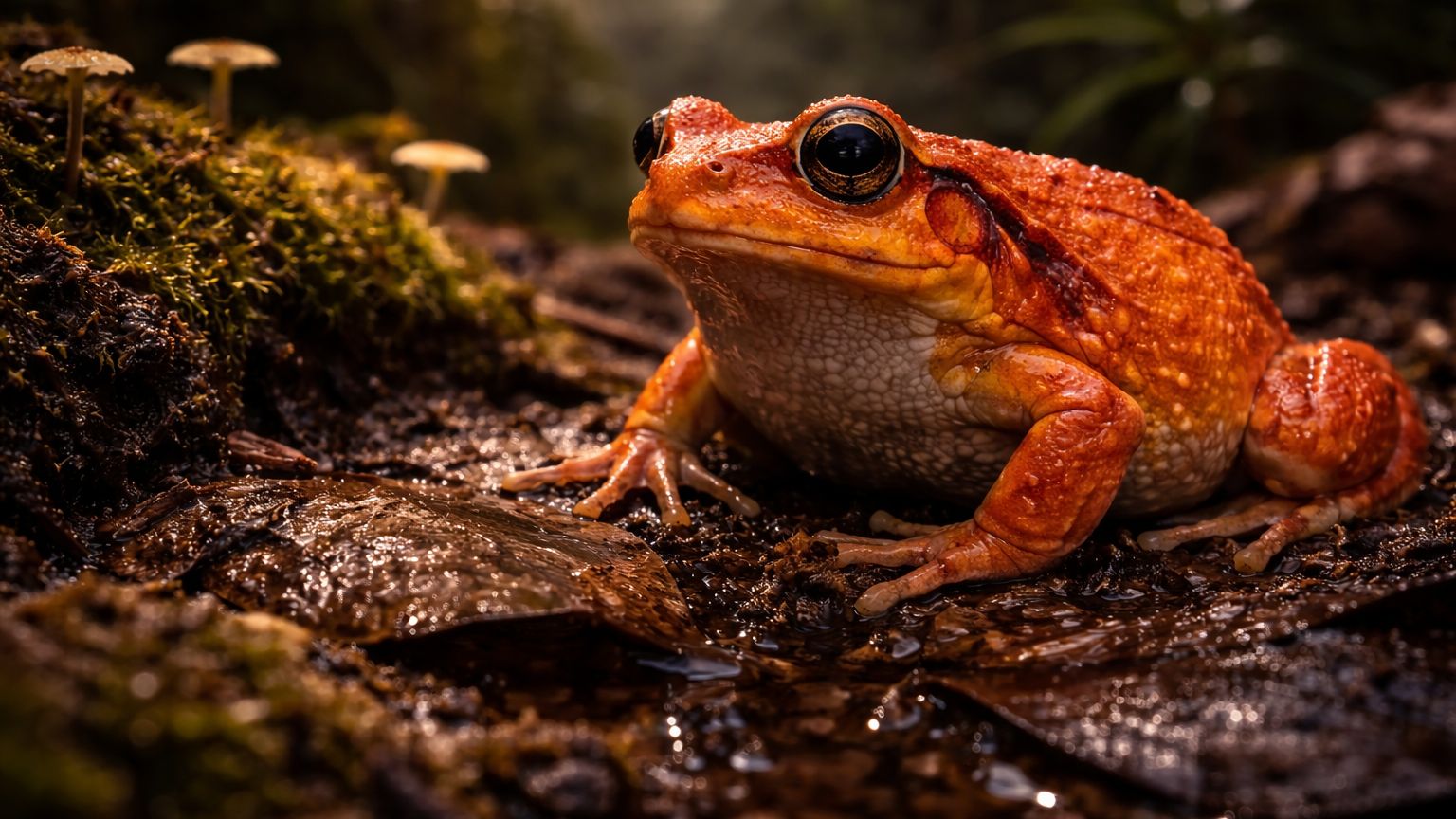
Madagascar’s Forest Floor Stage and the Places Tomato Frogs Prefer
Tomato Frogs are native to Madagascar, an island known for high levels of unique wildlife found nowhere else. Within Madagascar, they are most strongly associated with humid lowland areas, including coastal forests and nearby wetlands where moisture remains reliable. The rainforest floor in these habitats is a busy, layered environment where leaf litter traps humidity, fallen branches create shade, and small pools appear after rain. These conditions matter because frogs breathe partly through their skin, and drying out is a constant threat. A Tomato Frog’s habitat is less about dramatic trees and more about the quiet microclimate at ground level.
Seasonal rhythms shape where the frogs are active and when people notice them. During drier stretches, individuals may remain buried or tucked into hidden crevices, reducing their exposure and conserving moisture. After heavy rains, activity increases, and the frogs are more likely to appear near temporary pools, puddles, and waterlogged depressions. These wet spots can become gathering points for breeding and feeding, creating brief windows of visibility in an otherwise secretive life. If you picture the Tomato Frog as a bright red animal always on display, the habitat quickly corrects that impression, because most of the time it is a red secret under brown leaves.

The Signature Look: Color, Shape, and What the Body Reveals
The Tomato Frog’s most famous trait is its intense coloration, which ranges from orange to deep red in many individuals. Color can vary by sex and age, with females often being larger and sometimes more vividly colored, while males may appear smaller and slightly less bold. Beyond color, the frog’s body is built like a compact wedge, with a broad back, short limbs, and a rounded profile that supports burrowing. This is not a frog designed for long jumps across open ground. It is a frog designed to press into soil, disappear quickly, and hold position when threatened. The skin texture adds another layer to the story. In humid conditions, the frog can appear glossy, almost lacquered, because amphibian skin often holds a film of moisture that supports gas exchange and helps prevent dehydration. The head is relatively short, with eyes positioned for scanning while the body remains low. When the frog is resting, the posture looks grounded and deliberate, like a small animal that expects to be approached rather than one that plans to flee. Those physical clues match its behavior: it relies on concealment, chemical defense, and stillness more than speed.
A Life Built Around Moisture: Burrowing, Waiting, and Emerging
Tomato Frogs are well known for spending significant time partially buried in soil or leaf litter, especially when conditions are dry. Burrowing helps them retain moisture by surrounding the body with cooler, damp substrate that slows water loss. It also provides cover from predators and temperature extremes, creating a stable microenvironment even when the surface dries out. This strategy allows the frog to survive in habitats where rainfall is seasonal rather than constant. The result is a life pattern that can look quiet and inactive, but it is actually a carefully managed energy budget.
When the environment shifts, the frog shifts with it. Warm rains often trigger increased movement and feeding, and breeding activity commonly follows heavy rainfall when temporary water becomes available. That timing is not accidental, because temporary pools can reduce the number of fish and other aquatic predators that might eat eggs or tadpoles. The frog’s ability to stay hidden and then become active at the right moment is one of its most effective adaptations. It turns the rainforest’s unpredictability into a schedule that favors a small animal with limited mobility.
What Tomato Frogs Eat and How They Hunt Without Flashiness
Tomato Frogs are carnivorous and feed primarily on small invertebrates such as insects and other tiny ground-dwelling prey. Their hunting style is less about chase and more about ambush, taking advantage of stillness and camouflage despite their bright coloration. At night or during humid conditions, invertebrates move more actively across the forest floor, and the frog’s low, patient posture becomes a practical hunting method. A quick mouth movement and sticky tongue can secure prey in a fraction of a second. The frog does not need to run when its environment delivers prey to its doorstep. This feeding strategy connects directly to habitat choice. Leaf litter is full of small insects, and wet ground supports high invertebrate activity, especially after rain. A burrowing frog that emerges into that burst of life can feed efficiently without exposing itself for long periods. Over time, this contributes to the frog’s ecological role as a predator of small animals that influence decomposition and nutrient cycling. Even though it is not a large predator, it participates in the rainforest’s constant exchange of energy by converting insect activity into amphibian biomass that then becomes prey for larger animals.
The Unexpected Defense Toolkit: Sticky Secretions and Startle Power
One of the most distinctive defenses in Tomato Frogs is their ability to produce a sticky secretion from the skin when threatened. This secretion can be irritating and can gum up the mouthparts of predators, creating a strong incentive to release the frog. The defense works best when paired with the frog’s tendency to stay put rather than bolt, because it turns a close encounter into a messy, unpleasant experience. The frog may also inflate its body, making itself harder to swallow and giving the impression of greater size. These behaviors combine to create a defensive profile that relies on chemistry and physical tactics rather than speed.
The bright coloration is often discussed as a warning signal, and while color alone is not proof of toxicity, it can still function as a deterrent by advertising “unpleasant” qualities to predators. Many predators learn through experience, and even a single bad encounter can change behavior. In nature, a defense does not need to be fatal to be effective. It only needs to make predation a bad decision often enough to improve survival. The Tomato Frog’s defense toolkit shows how an amphibian can succeed with a strategy that is more about discouraging attacks than escaping them.

Voices in the Rain: Communication and Breeding Sounds
Tomato Frogs are not typically heard every night, but their vocal behavior becomes important during breeding periods. Males call to attract females, and calling often intensifies during warm, rainy conditions when breeding sites are available. The exact call character can vary, but the overall effect is a chorus that blends into the nighttime soundscape of frogs, insects, and dripping leaves. Calls serve multiple functions, including attracting mates and helping males maintain spacing or establish presence in a temporary breeding area. For general readers, it is a reminder that much of amphibian life is acoustic, even when the animals remain visually hidden. Breeding behavior is tied closely to water availability, because eggs and developing larvae usually require aquatic conditions. Temporary pools or flooded depressions can become brief nurseries where eggs hatch and tadpoles develop. This strategy can reduce exposure to predators found in permanent water bodies, but it also introduces urgency, because temporary water can vanish quickly. The frog’s reproductive timing is therefore both opportunistic and precise, matching biological processes to weather patterns. In a rainforest system, that kind of timing can be the difference between a successful generation and a failed one.
From Egg to Adult: Growth, Metamorphosis, and Survival Pressures
Like many frogs, Tomato Frogs undergo a life cycle that begins with eggs and continues through a tadpole stage before metamorphosis produces a land-capable juvenile. Tadpoles develop in water, feeding and growing until legs appear and the body reshapes for terrestrial life. Metamorphosis is a dramatic transformation, with gills giving way to lungs and the digestive system shifting as the diet changes. For a frog that spends so much adult time on land, the early aquatic stage remains essential. This dual life cycle is one reason amphibians are sensitive to changes in both terrestrial and aquatic habitats.
Survival pressures are intense at every stage. Eggs can be vulnerable to drying, predation, and microbial threats, while tadpoles face predators and the risk of shrinking water levels. Juveniles must learn to feed effectively while avoiding dehydration, and adults must balance the need to breed with the need to stay hidden and safe. The Tomato Frog’s adaptations, including burrowing and defensive secretions, help adults persist, but early stages rely heavily on timing and habitat conditions. This life cycle explains why rainy seasons feel like a biological trigger for amphibian activity, because they open a narrow window in which the next generation can begin.
How Tomato Frogs Fit Into Their Ecosystem
In the ecosystems of Madagascar, Tomato Frogs function as mid-level predators of small invertebrates and as prey for larger animals. Their feeding helps shape local insect populations, which can influence decomposition and the movement of nutrients through soil and leaf litter. By consuming insects that break down organic material or feed on plants, the frogs contribute indirectly to the balance of forest-floor processes. Their presence is also a sign of moisture and habitat structure that supports amphibian life. In that way, they become part of a larger pattern that includes plants, fungi, insects, and other amphibians. They also illustrate how a single species can carry public attention in a way that draws interest to less visible ecosystem components. People are naturally drawn to the bright red frog, and that attention can lead to broader curiosity about Madagascar’s habitats. When readers learn that the frog depends on humid microclimates and seasonal waters, they gain insight into how delicate and interconnected those systems can be. It becomes clear that the frog is not just a colorful animal but a living indicator of the forest floor’s health and stability. In ecosystems, even the most visually striking animal is still shaped by hidden processes.
Conservation in a Practical, Ground-Level Way
It is reasonable to discuss conservation for Tomato Frogs, but it helps to keep the focus practical and specific rather than alarming. Like many amphibians with specialized habitat needs, Tomato Frogs are affected by changes that reduce suitable moisture-rich environments, such as deforestation, drainage, and land conversion. When forests are fragmented, the shaded, humid microclimates that frogs rely on can shrink or disappear, even if some trees remain. Water quality and the availability of breeding pools can also shift as land use changes. These pressures do not necessarily mean the species is always in crisis everywhere, but they do highlight why habitat protection matters.
For general readers, a balanced view is that healthy forests and wetlands support not only Tomato Frogs but also the broader communities that make Madagascar unique. Conservation often looks like protecting habitat, supporting sustainable land practices, and encouraging research and monitoring so changes are noticed early. Captive breeding and responsible pet trade discussions sometimes appear around charismatic amphibians, and the key theme is that wild populations should not be treated as an unlimited source. A frog’s greatest defense is not just sticky secretions, but a landscape that still provides leaf litter, clean water, and seasonal rhythms. Keeping those basics intact is often the most meaningful approach.
Tomato Frogs in Human Imagination and Responsible Curiosity
The Tomato Frog’s popularity shows how color and naming can shape human perception. Many people remember it because the name is vivid, easy to picture, and slightly humorous, which makes it an effective ambassador for amphibians. That popularity can be positive when it leads to curiosity about amphibians, rainforest ecology, and Madagascar’s extraordinary biodiversity. It can also create misconceptions, such as the idea that the frog is always bright red, always visible, or always living in water. A more accurate picture is a secretive animal that uses color as one tool among many, living most of its life close to the soil. Responsible curiosity means focusing on observation, learning, and habitat respect rather than disturbance. Amphibians are sensitive to oils and residues on human skin, and unnecessary handling can stress them or expose them to pathogens. For readers inspired to learn more, the best approach is to explore credible natural history sources and, when possible, observe amphibians at night in wet seasons without interfering. The Tomato Frog offers a reminder that the most memorable animals are not always the loudest or the largest. Sometimes they are the ones that teach us how much life is happening at ground level.
A Bright Symbol of Madagascar’s Quiet Complexity
The Tomato Frog remains one of the most recognizable amphibians linked to Madagascar, yet its true appeal is how it combines bold color with a life strategy built on patience. Dyscophus antongilii is not a creature of constant motion, but of timing, moisture management, and defensive chemistry. Its story connects rainforest microclimates to seasonal rains, and insect activity to amphibian survival. For general readers, it is a species that makes amphibian biology feel approachable because the adaptations are visible and intuitive. When you see a compact frog that can burrow and defend itself with sticky secretions, you can almost read the environment it evolved in.
This is the kind of animal that encourages exploration beyond the headline features. Once you move past the red coloration, you find a rainforest-floor specialist whose life is shaped by water availability and hidden habitat structure. That discovery can lead naturally to related topics, such as Madagascar’s other endemic frogs, the role of leaf litter in ecosystems, and the surprising variety of amphibian defenses. The Tomato Frog works well as a starting point for a broader journey into amphibians, because it is memorable and biologically rich at the same time. When you are ready to explore further, its world opens into a larger map of Madagascar’s living details.