
A Living Legend Beneath the Water’s Surface
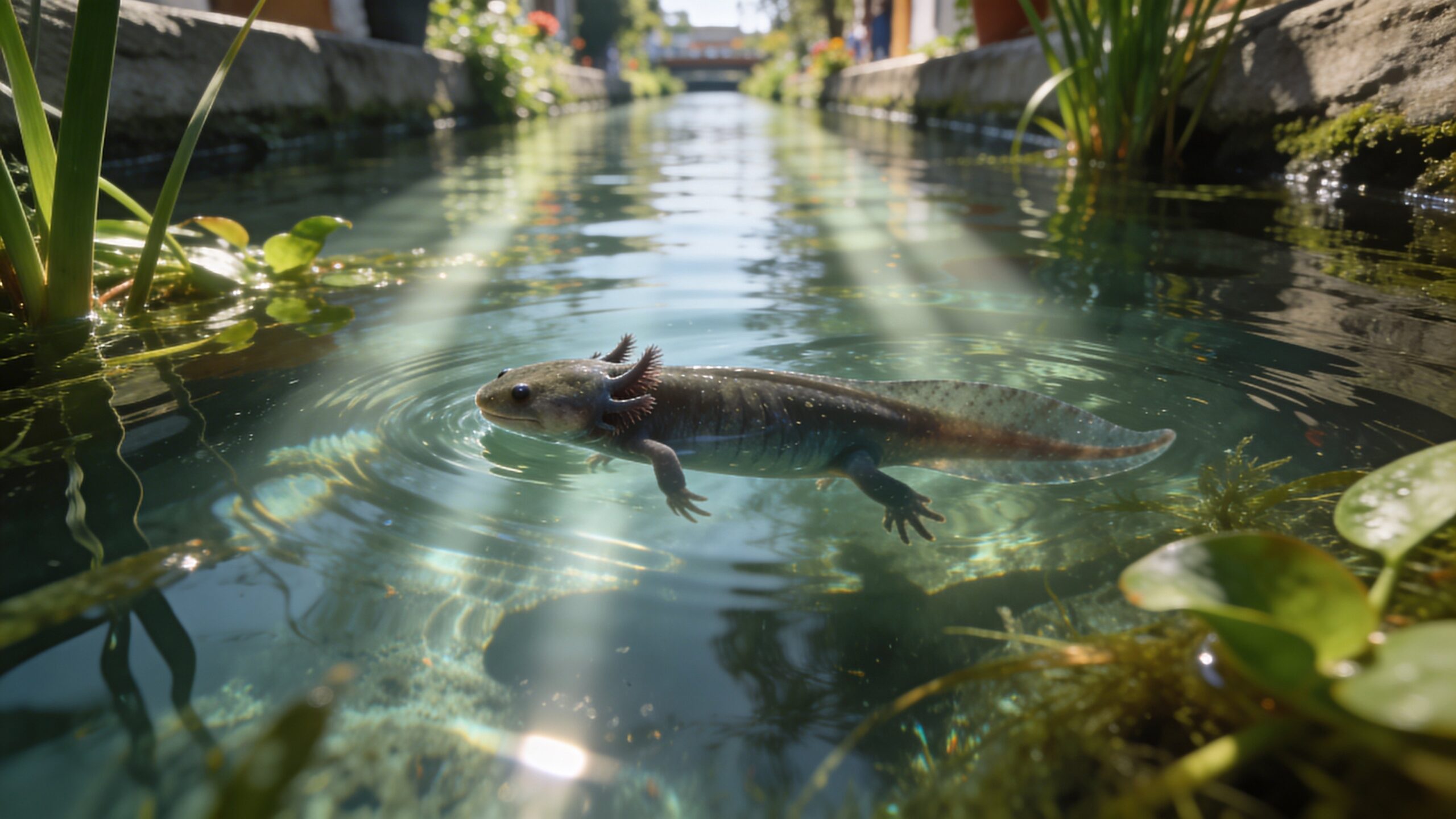
The axolotl, scientifically known as Ambystoma mexicanum, is one of the most unusual and captivating amphibians on Earth. Native to freshwater systems in central Mexico, this creature has gained global attention for its distinct appearance and extraordinary biological abilities. With its feathery external gills, wide-set eyes, and perpetual “smile,” the axolotl appears almost otherworldly. Yet beyond its charming exterior lies a complex organism that challenges many of the assumptions scientists have about growth, healing, and evolution. Unlike most amphibians, the axolotl does not undergo full metamorphosis into a land-dwelling adult. Instead, it retains its aquatic larval features throughout its life, a phenomenon known as neoteny. This unique developmental path allows it to remain fully aquatic while still reaching sexual maturity. The result is an animal that blurs the boundaries between juvenile and adult forms, offering a fascinating window into developmental biology. For general readers, the axolotl is both an accessible curiosity and a gateway into deeper scientific questions about life itself.
A: Start with body shape and habitat, then use color, markings, size, and behavior as confirmation.
A: Because Axolotl has its own mix of structure, habitat, feeding, and comparison clues.
A: Compare it with the nearest parent, child, or lookalike pages before treating one trait as final.
A: No. Age, season, lighting, region, and posture can all change the first impression.
A: Look for the setting that explains the animal: water, cover, vegetation, substrate, altitude, reef, burrow, branch, or open ground.
A: The exact diet depends on the animal, but mouth shape, movement, and habitat usually reveal the feeding strategy.
A: Many animals change size, color, pattern, diet, risk, or habitat between young and adult stages.
A: Use the photo to check eye position, body outline, limbs or fins, texture, posture, and surrounding habitat.
A: Yes. Every animal affects food webs, habitat structure, competition, nutrient movement, or predator-prey balance in some way.
A: It should connect the animal's visible traits to how it survives, moves, feeds, and fits the taxonomy.
The Origins of an Iconic Species
The axolotl’s story begins in the ancient lake systems of central Mexico, particularly Lake Xochimilco and Lake Chalco. These waterways once formed an extensive network of wetlands that supported a wide range of species, including early human civilizations. The axolotl became deeply embedded in local culture, even appearing in mythology as a symbol of transformation and survival. Over time, however, environmental changes dramatically reduced its natural habitat, leaving only fragments of its original range.
Despite these challenges, the axolotl has persisted, both in the wild and in human care. Its cultural and scientific importance has ensured its survival beyond its shrinking natural environment. Today, it is studied in laboratories around the world and kept in aquariums as a unique and educational species. Its origins, rooted in both ecological history and human storytelling, continue to shape how it is understood and appreciated today.

Anatomy That Defies Expectations
At first glance, the axolotl’s anatomy seems almost playful, but every feature serves a functional purpose. Its external gills, which resemble delicate branches extending from the sides of its head, are highly efficient structures for extracting oxygen from water. These gills can even change slightly in color and size depending on environmental conditions, reflecting the animal’s physiological state. Its skin, smooth and permeable, plays a role in respiration as well, allowing additional oxygen exchange directly through its surface. The axolotl’s limbs are another point of interest, particularly because of their role in regeneration. Each limb contains a complex network of tissues that can reorganize and rebuild when damaged. Its tail, often used for propulsion, is equally capable of regeneration, demonstrating the consistency of this ability across different body parts. Even its internal organs exhibit regenerative potential, making the axolotl a rare example of an organism with widespread healing capabilities. This combination of features creates a body plan that is both efficient and remarkably adaptable.
The Science of Regeneration
Perhaps the most famous aspect of the axolotl is its ability to regenerate lost body parts. Unlike many animals that can only heal wounds, the axolotl can fully regrow limbs, spinal cord segments, and even portions of its heart and brain. This process involves the formation of a specialized structure called a blastema, where cells gather and reorganize to rebuild the missing tissue. The regenerated part is not a simple replacement but a fully functional structure that integrates seamlessly with the rest of the body.
Scientists have studied this process extensively to understand how it might apply to human medicine. While humans possess limited regenerative abilities, the axolotl demonstrates what is biologically possible under different conditions. Its cells can revert to a more flexible state, allowing them to develop into various tissue types as needed. This adaptability is controlled by a complex interplay of genetic and environmental factors, making the axolotl a valuable model for research. The study of its regenerative abilities continues to inspire new approaches to healing and tissue repair.
Life in a Permanent Youthful State
The concept of neoteny is central to understanding the axolotl’s biology. While most amphibians undergo a transformation from aquatic larvae to terrestrial adults, the axolotl retains its larval features throughout its life. This means it keeps its gills, aquatic lifestyle, and certain physiological traits that would typically disappear during metamorphosis. Despite this, it reaches full reproductive maturity, functioning as an adult without undergoing the expected developmental changes. This unique life strategy offers several advantages, particularly in stable aquatic environments where leaving the water is unnecessary. By remaining in its larval form, the axolotl avoids the risks associated with transitioning to land. However, under certain conditions, such as exposure to specific hormones, it can undergo metamorphosis and become more like its terrestrial relatives. This flexibility highlights the complexity of its developmental biology and underscores the diversity of life strategies found in amphibians.
Behavior and Daily Life
In its natural environment, the axolotl leads a relatively calm and deliberate life. It spends much of its time near the bottom of freshwater habitats, moving slowly and conserving energy. Its diet consists primarily of small aquatic organisms, including worms, insects, and small fish. Using a suction-based feeding method, it draws prey into its mouth with surprising efficiency, relying more on stealth than speed.
The axolotl’s behavior reflects its role as both predator and prey within its ecosystem. Its muted coloration helps it blend into its surroundings, providing a degree of protection from larger animals. At the same time, its sensory systems allow it to detect movement and vibrations in the water, aiding in both hunting and awareness of potential threats. This balance of caution and capability defines its daily existence, making it a quiet but effective participant in its environment.

Habitat and Environmental Needs
Axolotls are highly specialized for life in freshwater environments, particularly those with cool temperatures and stable conditions. Historically, they thrived in the canals and lakes of central Mexico, where water quality and vegetation supported a diverse ecosystem. These habitats provided both food and shelter, allowing the axolotl to maintain its unique lifestyle without significant competition from other species. Changes in water quality, urban development, and the introduction of non-native species have significantly altered these environments. While axolotls can adapt to a range of conditions in controlled settings, their natural habitat requires a delicate balance of factors to remain viable. Understanding these environmental needs is essential for both conservation efforts and the responsible care of axolotls in captivity. Their reliance on specific conditions highlights the interconnected nature of ecosystems and the challenges of preserving them.
Color Variations and Genetic Diversity
One of the reasons the axolotl has become so popular in aquariums is its wide range of color variations. In the wild, it typically exhibits a dark, mottled appearance that provides camouflage against the lakebed. In captivity, selective breeding has produced a variety of colors, including leucistic (pale with dark eyes), albino, golden, and even more unusual patterns. These variations are the result of genetic differences that influence pigmentation and other physical traits.
Despite these differences in appearance, all axolotls share the same fundamental biological characteristics. Their regenerative abilities, neotenic development, and aquatic lifestyle remain consistent across color variations. This combination of visual diversity and biological consistency makes them both scientifically valuable and visually appealing. It also demonstrates how genetic variation can exist within a species without altering its core identity.
The Axolotl in Science and Culture
The axolotl has played a significant role in both scientific research and cultural expression. In laboratories, it is used to study regeneration, development, and genetic processes. Its unique abilities provide insights that are difficult to obtain from other organisms, making it a key subject in biological research. At the same time, it has captured the imagination of artists, writers, and educators, appearing in various forms of media and storytelling. Its cultural significance extends back to ancient traditions, where it was associated with transformation and resilience. Today, it continues to serve as a symbol of curiosity and discovery. Whether encountered in a classroom, a research facility, or an aquarium, the axolotl invites people to reconsider what is possible in the natural world. Its presence bridges the gap between science and storytelling, making it a powerful and enduring figure.
Conservation in a Changing World
While the axolotl remains widely available in captivity, its wild population has declined significantly. Habitat loss, pollution, and invasive species have all contributed to this decline, reducing the areas where it can survive naturally. Conservation efforts focus on restoring and protecting its remaining habitats, as well as raising awareness about its ecological importance.
These efforts are supported by both local initiatives and international interest, reflecting the axolotl’s global significance. While it is not necessary to emphasize urgency, it is important to recognize the challenges it faces. By understanding its role in the ecosystem and the factors affecting its survival, people can contribute to a more informed perspective on conservation. The axolotl’s story is not only about what it is, but also about the environment that sustains it.
Why the Axolotl Continues to Fascinate
The enduring appeal of the axolotl lies in its ability to combine simplicity with complexity. On the surface, it is an approachable and visually distinctive animal that captures attention بسهولة. Beneath that surface, however, it represents some of the most intriguing questions in biology, from regeneration to development and adaptation. This dual nature makes it accessible to general readers while remaining deeply relevant to scientific inquiry. As interest in the natural world continues to grow, the axolotl stands out as a reminder of how much there is still to learn. Its unique characteristics challenge assumptions and inspire curiosity, encouraging a deeper appreciation for biodiversity. Whether viewed as a scientific model, a cultural symbol, or simply a fascinating creature, the axolotl offers a rich and engaging subject for exploration.
Animal Product Reviews
Dive into Animal Streets’ Animal Product Reviews — your guide to the best gear, gifts, books, and gadgets inspired by the animal kingdom. From land-roaming lions to ocean-gliding whales, from household pets to prehistoric giants, we explore top-rated products for enthusiasts, educators, and animal lovers alike. Whether you’re shopping for toys, decor, field gear, or fun collectibles, we’ve sniffed out the best so you can discover it all in one wild place!