

Rainforest Haven: Habitat and Range
The bonobo is found exclusively in the dense tropical rainforests of the central Congo Basin in the Democratic Republic of the Congo (DRC). Its range is bounded by the Congo River to the north and west, and by the Kasai and Sankuru rivers to the south and east. This restricted distribution makes the bonobo one of the most geographically limited of all great apes.
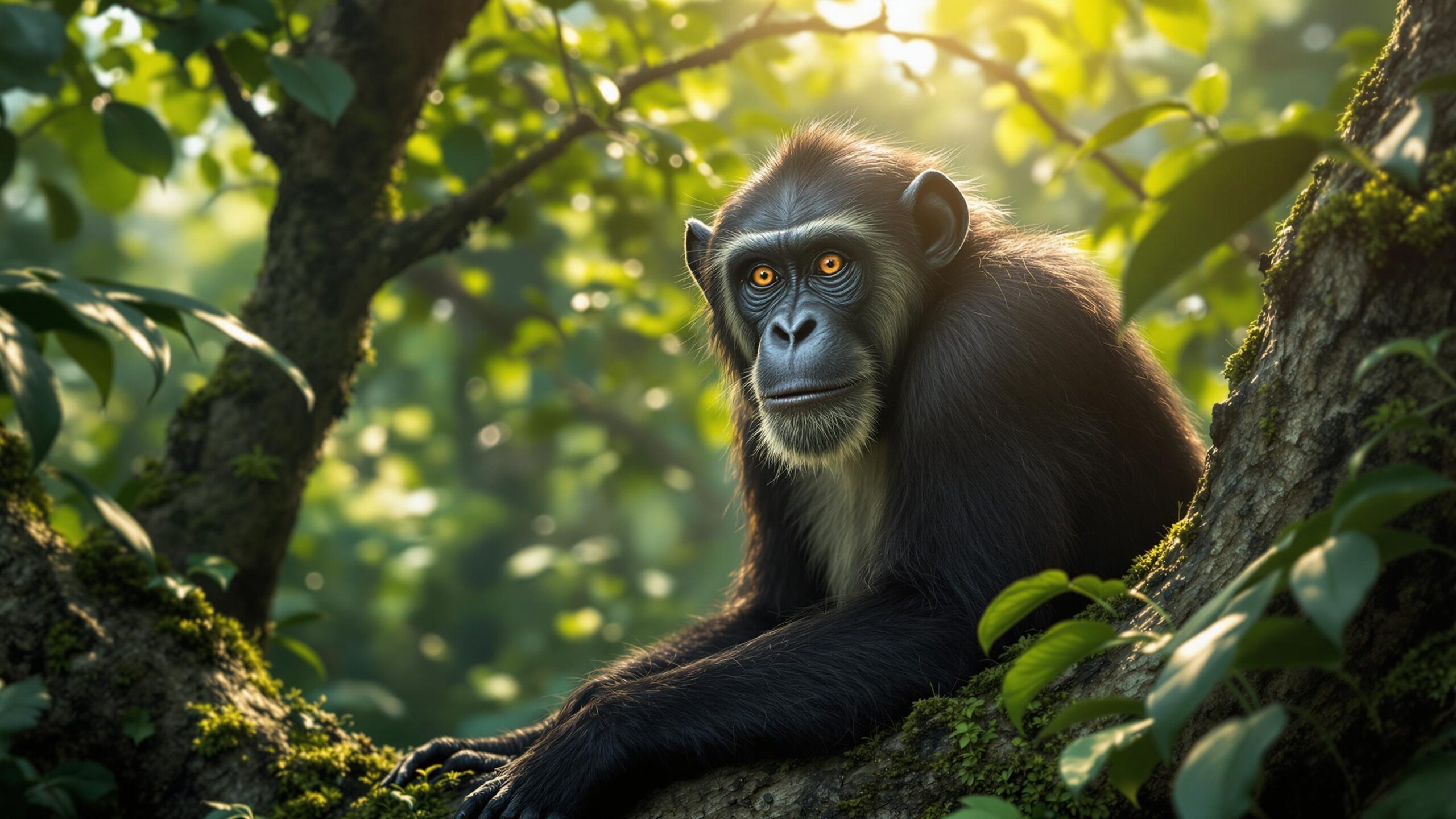
The bonobo’s natural habitat is characterized by lush, humid forest landscapes teeming with biodiversity. Towering trees, tangled lianas, and a dense understory provide food, shelter, and mobility for these arboreal primates. Bonobos spend much of their time in the trees but are equally at ease on the forest floor, walking upright with a grace and fluidity that often surprises observers. This habitat, though rich, is also fragile. The increasing pressures of logging, agriculture, and human encroachment have made bonobo conservation a priority, but we’ll return to that topic later.
Graceful Bodies, Expressive Faces
Physically, bonobos are smaller and more slender than chimpanzees. Adults typically weigh between 60 and 90 pounds and stand about three to four feet tall when upright. Their build is lean and elongated, with long legs, small faces, and slightly parted pink lips that often seem to wear a subtle smile. One of the most striking features of the bonobo is its expressive face. With dark eyes framed by prominent brows, bonobos convey emotion through subtle changes in facial expression, much like humans. Their skin is typically black, and their fine black hair gives them a sleek, elegant appearance. Bonobos also display sexual dimorphism, but it is less pronounced than in chimpanzees. Males and females are more similar in size and strength, contributing to a more balanced power dynamic within groups. Their overall physicality—agile, intelligent, and graceful—supports both their social complexity and arboreal agility.
Minds of Empathy: Intelligence and Social Cooperation
The bonobo is one of the most intelligent non-human animals alive today. Their cognitive abilities are evident in their problem-solving skills, emotional sensitivity, and capacity for social learning. Bonobos can understand symbols, use basic tools, and even grasp aspects of grammar and syntax in controlled studies. However, it’s not just their intellect that sets them apart—it’s their empathy. Bonobos are masters of social harmony, often choosing peace over conflict. Where chimpanzees may resolve disputes with force, bonobos often employ affection, play, and grooming. This tendency toward reconciliation rather than retaliation has led to their reputation as the “hippies” of the ape world.
In bonobo society, social bonds are critical. Grooming is a key component of community life, reinforcing alliances and easing tensions. Emotional awareness seems deeply ingrained; bonobos can comfort distressed individuals, offer help without reward, and even show signs of grief after the loss of a group member. Such behaviors suggest a highly developed sense of self and others—an emotional intelligence that rivals our own.
Matriarchs and Harmony: Group Structure
Perhaps the most remarkable aspect of bonobo life is its matriarchal structure. Unlike chimpanzee societies, where males typically dominate, bonobo groups are led by females. Older, experienced females often hold high-ranking positions and influence key group decisions, including movement, foraging, and conflict resolution. Males gain status largely through their mothers, a relationship that shapes the social fabric of bonobo life. This maternal influence fosters an environment where cooperation is rewarded over aggression, and harmony is prioritized over hierarchy.
Bonobos live in multi-male, multi-female groups that can number from 20 to over 100 individuals. These groups are fluid and dynamic, often forming temporary subgroups for foraging and travel. This fission-fusion social system allows flexibility and reduces resource competition, fostering a sense of community even in a large and varied group. Conflict, while not absent, is typically resolved with minimal violence. Physical confrontations are rare, and when they occur, they are often quickly diffused through grooming or other affiliative behaviors.
Intimacy as Communication
Bonobos are famously affectionate animals, and sexual behavior plays a prominent role in their social interactions. But it’s important to understand this behavior in context: for bonobos, intimacy is not just reproductive—it’s communicative. Sexual contact is used to ease social tensions, reinforce bonds, celebrate reunions, and defuse potential conflicts. This behavior occurs among all combinations of age and gender and is characterized by its frequency, variety, and apparent mutual consent.
In many ways, bonobos have turned intimacy into a social language—a means of saying “I trust you,” “Let’s stay friends,” or “We’re safe together.” While this behavior has raised eyebrows in the past, researchers now understand it as a sophisticated and adaptive form of communication that reinforces peace and cohesion in bonobo society. This openness and emotional fluency underscore just how different—and how fascinating—bonobos are among great apes.
Foraging, Feeding, and Everyday Life
Bonobos are omnivores, but their diet is largely plant-based. Fruits, especially figs, make up the bulk of their intake, followed by leaves, seeds, flowers, and stems. Occasionally, they will consume small vertebrates, insects, or eggs, though they are less carnivorous than chimpanzees. Foraging is a group activity, and bonobos often travel long distances in search of food, moving gracefully through the trees or walking upright through underbrush. They show an impressive knowledge of their environment, remembering the location and seasonal cycles of fruiting trees.
While tool use in bonobos is less frequent than in chimpanzees, they are known to manipulate sticks, leaves, and other natural objects in various tasks. In captivity, their tool-making skills and problem-solving abilities shine, often matching or surpassing those of chimpanzees. Daily life in a bonobo group includes resting, grooming, playing, traveling, foraging, and socializing. Play is a vital part of bonobo culture, not just for juveniles but for adults as well. Through play, they build social ties, practice coordination, and test social boundaries in a safe and enjoyable way.
Childhood in the Canopy: Reproduction and Development
Female bonobos give birth approximately every five to six years after a gestation period of about 240 days. Infants are born completely dependent, clinging to their mothers for warmth, nourishment, and protection. The bond between mother and child is deep and enduring, often lasting for many years beyond infancy. Infants breastfeed for about four years and may continue to travel closely with their mothers for several years after weaning. this time, young bonobos learn vital survival and social skills through observation, imitation, and interaction.
Motherhood is central to bonobo society. Female alliances often revolve around shared care, and even older offspring may assist in protecting or grooming younger siblings. Male bonobos also display nurturing behaviors, though to a lesser degree than females. This prolonged developmental period is one of the reasons bonobos live rich, complex social lives—it gives them the time and support to learn the intricate rules of their community.
A Fragile Future: Conservation Challenges
Despite their remarkable intelligence and emotional depth, bonobos face significant threats in the wild. Habitat destruction due to logging, slash-and-burn agriculture, and mining is reducing the forests they depend on. Civil unrest in the region has made conservation efforts difficult, while poverty and lack of infrastructure hinder long-term planning. Bonobos are also victims of poaching. Although it is illegal, bushmeat hunting persists in some areas, and bonobo meat is sometimes traded for status or profit. Orphaned infants are occasionally captured and sold, often dying in the process or living out their lives in captivity.
The International Union for Conservation of Nature (IUCN) classifies bonobos as Endangered, with population estimates ranging between 10,000 and 20,000 individuals. However, due to the difficulty of accessing remote regions, exact numbers remain uncertain. Despite these challenges, dedicated conservation groups are working hard to protect bonobos through sanctuary efforts, education programs, and habitat preservation. Organizations like the Bonobo Conservation Initiative and Lola ya Bonobo Sanctuary in Kinshasa are making strides in raising awareness and providing direct care to rescued individuals.
What Bonobos Teach Us
More than just fascinating animals, bonobos offer valuable insight into the evolution of empathy, cooperation, and peace. In a world often shaped by competition and conflict, the bonobo reminds us that kindness and connection can also be powerful forces for survival and success. Their societies are not utopias—they have struggles and hierarchies like any species—but the overall tone is one of mutual respect and emotional sensitivity. Bonobos show us that another way of being is not only possible—it’s already happening in the forests of the Congo. Studying bonobos may also help us understand the human condition better. By comparing our behaviors, communication styles, and emotional patterns with those of bonobos, we gain a clearer picture of what makes us uniquely human—and what we still share with our evolutionary cousins.
A Species Worth Protecting
Bonobos are one of nature’s most extraordinary gifts—a species that embodies the best traits of the animal kingdom and holds a mirror to our own nature. As intelligent, emotionally rich, and socially complex beings, they deserve not only our admiration but our protection. Their lives offer a glimpse into an alternate evolutionary path—one guided not by force and fear but by trust, empathy, and connection. In many ways, the story of the bonobo is a story of hope. Hope that peace and cooperation can lead to thriving societies. Hope that compassion has evolutionary value. And hope that we still have time to safeguard a species that has so much to teach us about life, love, and what it means to be alive.