
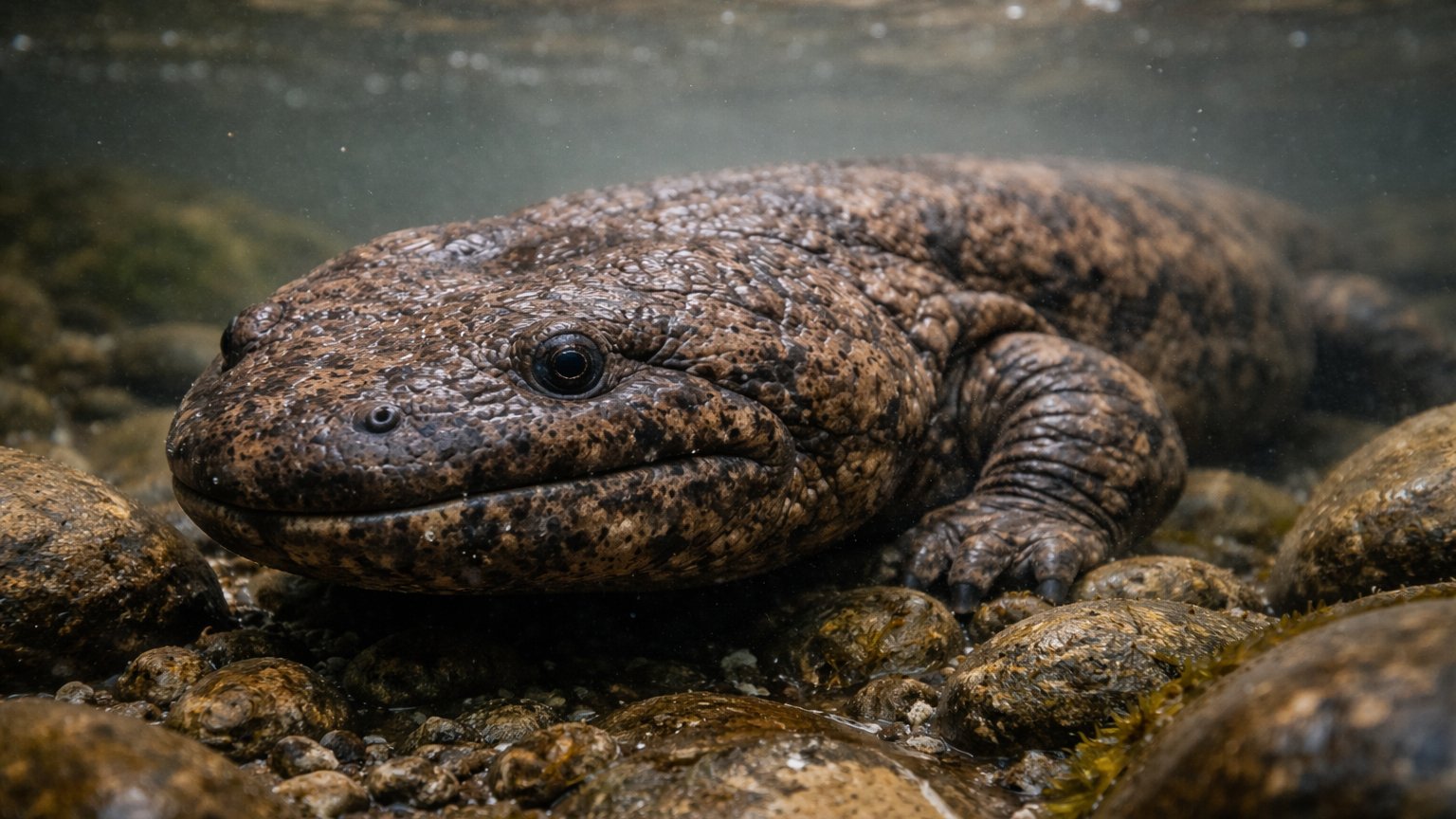
A Hidden World of Living Fossils
Deep beneath the surface of cold mountain streams and shadowed rivers lives a group of animals that seem to belong to another era entirely. Giant salamanders, among the largest amphibians on Earth, are often described as living fossils, not because they are outdated, but because they have retained ancient biological traits that stretch back millions of years. These creatures move slowly through freshwater systems, blending seamlessly with rocks and sediment, their presence often unnoticed even in habitats they have occupied for generations. Their broad heads, flattened bodies, and textured skin give them an almost prehistoric appearance, yet they remain remarkably well adapted to the environments they inhabit. What makes giant salamanders especially compelling is how they bridge the gap between past and present. They offer a rare glimpse into early amphibian evolution while continuing to play vital roles in modern ecosystems. Their biology, behavior, and ecological importance form the foundation of a category that is both scientifically significant and endlessly fascinating. As a pillar topic, giant salamanders open the door to a deeper understanding of amphibians as a whole, revealing how specialized adaptations can shape survival in specific environments.
A: Start with body shape and habitat, then use color, markings, size, and behavior as confirmation.
A: Because Giant Salamanders has its own mix of structure, habitat, feeding, and comparison clues.
A: Compare it with the nearest parent, child, or lookalike pages before treating one trait as final.
A: No. Age, season, lighting, region, and posture can all change the first impression.
A: Look for the setting that explains the animal: water, cover, vegetation, substrate, altitude, reef, burrow, branch, or open ground.
A: The exact diet depends on the animal, but mouth shape, movement, and habitat usually reveal the feeding strategy.
A: Many animals change size, color, pattern, diet, risk, or habitat between young and adult stages.
A: Use the photo to check eye position, body outline, limbs or fins, texture, posture, and surrounding habitat.
A: Yes. Every animal affects food webs, habitat structure, competition, nutrient movement, or predator-prey balance in some way.
A: It should connect the animal's visible traits to how it survives, moves, feeds, and fits the taxonomy.

Chinese Giant Salamander
The Chinese giant salamander, scientifically known as Andrias davidianus, is one of the most extraordinary amphibians on Earth and holds the distinction of being the largest living amphibian species. Native to freshwater systems in China, this elusive creature has fascinated scientists and nature enthusiasts alike for centuries due to its immense size, ancient lineage, and unusual appearance. It belongs to a group of amphibians that have changed very little over

Hellbender
The Hellbender is one of North America’s most fascinating and least understood creatures, often described as a living relic of ancient amphibian lineages. Scientifically known as Cryptobranchus alleganiensis, this large, fully aquatic salamander inhabits cool, fast-flowing rivers and streams, primarily in the eastern United States. Despite its intimidating name and unusual appearance, the hellbender is a harmless and ecologically important species that plays a critical role in freshwater ecosystems. Its

Japanese Giant Salamander
A river giant with an ancient name The Japanese giant salamander, Andrias japonicus, is one of the most remarkable amphibians on Earth and one of Japan’s most distinctive native animals. It belongs to an ancient family of salamanders that includes some of the largest amphibians ever known, and it has a look that feels almost prehistoric at first glance. With its broad flattened head, wrinkled skin, tiny eyes, and heavy
The Biological Blueprint of Giant Salamanders
Giant salamanders belong to the family Cryptobranchidae, a group distinguished by its size, aquatic lifestyle, and unique respiratory adaptations. Unlike many amphibians that transition between aquatic and terrestrial environments, giant salamanders remain fully aquatic throughout their lives. Their bodies are built for this existence, with flattened heads that help them navigate currents and broad tails that provide steady propulsion. Their skin is loose and wrinkled, increasing surface area for oxygen absorption, which is essential because they rely heavily on cutaneous respiration rather than lungs.
Their sensory systems are equally specialized, allowing them to detect vibrations and subtle movements in the water. This adaptation is particularly important for hunting, as giant salamanders are primarily nocturnal predators that rely more on touch and water displacement than on vision. Their metabolism is relatively slow, enabling them to survive in environments where food may not always be abundant. This combination of physical and physiological traits creates a blueprint that has remained effective for millions of years, demonstrating how stability can be as powerful as change in the natural world.
Rivers, Mountains, and the Geography of Survival
The natural habitats of giant salamanders are as distinctive as the animals themselves. These amphibians are typically found in cool, fast-flowing streams and rivers, often in mountainous regions where water remains oxygen-rich and temperatures stay relatively stable. The structure of these waterways, including rocks, crevices, and submerged logs, provides both shelter and hunting grounds. These environments are not just places where giant salamanders live; they are integral to how they function as organisms. Geographically, giant salamanders are concentrated in parts of Asia and North America, with each region supporting species that have adapted to local conditions. The rivers they inhabit are often isolated, creating natural boundaries that shape the distribution and diversity of the group. This geographic specialization highlights the importance of freshwater ecosystems, which, despite covering a small portion of the Earth’s surface, support a remarkable range of life. For giant salamanders, these waterways are not merely habitats but entire worlds defined by flow, temperature, and structure.
The Chinese Giant Salamander: A Colossal Presence
Among the most iconic members of this group is the Chinese giant salamander, known scientifically as Andrias davidianus. This species is often recognized as the largest amphibian in the world, capable of reaching lengths that rival some small mammals. Its size alone makes it a standout, but its ecological role is equally significant. As a top predator in its environment, it helps regulate populations of smaller aquatic organisms, contributing to the balance of its ecosystem.
The Chinese giant salamander’s behavior reflects its size and environment. It is primarily nocturnal, spending daylight hours hidden beneath rocks or within underwater cavities. At night, it emerges to hunt, using its sensitive skin to detect prey in the dark waters. Its presence in cultural history and scientific research has made it one of the most studied amphibians, offering insights into growth, development, and environmental adaptation. As a flagship species, it represents both the grandeur and complexity of the giant salamander category.
The Japanese Giant Salamander: A Master of Adaptation
Closely related to its Chinese counterpart is the Japanese giant salamander, or Andrias japonicus. While slightly smaller on average, it is no less impressive in its adaptations and ecological role. Found in Japan’s clear, cool rivers, this species has developed behaviors and physical traits that allow it to thrive in environments shaped by seasonal changes and varying water conditions. Its mottled coloration provides excellent camouflage, helping it remain hidden from both predators and prey. The Japanese giant salamander is also known for its territorial behavior, particularly during breeding seasons. Males guard nesting sites and compete for access to prime locations, demonstrating a level of social interaction that adds complexity to its life history. This species has become a symbol of freshwater conservation in Japan, reflecting the deep connection between local ecosystems and cultural identity. Its story illustrates how a single species can embody both biological significance and regional heritage.
The Hellbender: North America’s Hidden Giant
In North America, the giant salamander lineage is represented by the hellbender, scientifically known as Cryptobranchus alleganiensis. Though smaller than its Asian relatives, the hellbender is still one of the largest salamanders on the continent. It inhabits clear, fast-flowing streams, particularly in the eastern United States, where it relies on clean, well-oxygenated water to survive. Its flattened body and wide head are perfectly suited to slipping beneath rocks, where it spends much of its time.
The hellbender’s ecological role is closely tied to water quality. Because it is sensitive to pollution and habitat changes, its presence often indicates a healthy ecosystem. This makes it an important species for monitoring environmental conditions. Despite its somewhat unusual appearance, the hellbender plays a crucial role in maintaining the balance of its habitat. Its inclusion in the giant salamander category highlights the diversity of forms and adaptations within this group, showing how similar biological principles can manifest in different environments.
Behavior Beneath the Surface
The behavior of giant salamanders is shaped by their environment and evolutionary history. These animals are primarily nocturnal, emerging under the cover of darkness to hunt and explore their surroundings. Their movements are deliberate and energy-efficient, reflecting a lifestyle that prioritizes conservation over speed. When hunting, they rely on sudden bursts of motion, capturing prey with a quick opening of the mouth that creates suction. Communication among giant salamanders is subtle, often involving physical interactions and environmental cues rather than vocalizations. During breeding seasons, however, behavior becomes more dynamic, with individuals competing for territory and mates. These interactions reveal a level of complexity that is not immediately apparent from their quiet, hidden lifestyles. By observing their behavior, researchers gain insights into how ancient survival strategies continue to function in modern ecosystems.
Ecological Importance and Freshwater Balance
Giant salamanders occupy a unique position within their ecosystems, acting as both predators and indicators of environmental health. Their role in controlling populations of smaller aquatic organisms helps maintain balance within freshwater systems. At the same time, their sensitivity to changes in water quality makes them valuable indicators of ecological stability. When giant salamanders thrive, it often signals that the surrounding environment is functioning well.
Their presence also influences the structure of their habitats. By occupying specific niches and interacting with other species, they contribute to the overall dynamics of their ecosystems. This interconnectedness underscores the importance of preserving freshwater habitats, not just for giant salamanders but for the countless other species that share these environments. Understanding their ecological role provides a broader perspective on how individual species contribute to the health of entire ecosystems.
Conservation Without Alarm
While giant salamanders face challenges related to habitat loss, pollution, and environmental change, their story is not solely one of decline. Conservation efforts in various regions aim to protect and restore the waterways they depend on, emphasizing sustainable practices and habitat preservation. These initiatives often involve collaboration between scientists, local communities, and policymakers, reflecting a shared interest in maintaining ecological balance. Rather than focusing on urgency, it is more useful to view conservation as an ongoing process that adapts to changing conditions. Giant salamanders serve as reminders of the importance of long-term environmental stewardship. By understanding their needs and the factors that influence their survival, people can contribute to more informed and effective conservation strategies. Their continued presence in both wild and managed environments suggests that with thoughtful approaches, these ancient creatures can remain part of our world.
Exploring the Subcategories Ahead
The category of giant salamanders is more than a collection of species; it is a gateway into a deeper understanding of amphibian life. Each subcategory, from the massive Chinese and Japanese species to the more regionally adapted hellbender, offers a unique perspective on how organisms interact with their environments. These subcategories reveal patterns of adaptation, behavior, and ecological significance that extend beyond individual species.
For readers, exploring these subcategories provides an opportunity to engage with the diversity and complexity of life in freshwater systems. Each species has its own story, shaped by geography, evolution, and environmental conditions. By delving into these stories, one can gain a richer appreciation for the natural world and the intricate relationships that define it. The journey through giant salamanders is not just about understanding a group of animals; it is about discovering the broader principles that govern life itself.
A Quiet Invitation to Discover More
Giant salamanders do not command attention in the way that more visible animals might, yet their quiet existence holds profound significance. They represent continuity, adaptation, and the enduring power of life to persist across vast stretches of time. Their presence in hidden waterways invites curiosity and exploration, encouraging a closer look at the environments that sustain them. As a pillar category, giant salamanders offer a foundation for further discovery. Each subcategory leads to new insights, new questions, and new connections within the natural world. For those willing to look beyond the surface, these amphibians provide a rich and rewarding subject of study. Their story is ongoing, shaped by both natural processes and human understanding, and it continues to unfold in the rivers and streams where they quietly thrive.
Animal Product Reviews
Dive into Animal Streets’ Animal Product Reviews — your guide to the best gear, gifts, books, and gadgets inspired by the animal kingdom. From land-roaming lions to ocean-gliding whales, from household pets to prehistoric giants, we explore top-rated products for enthusiasts, educators, and animal lovers alike. Whether you’re shopping for toys, decor, field gear, or fun collectibles, we’ve sniffed out the best so you can discover it all in one wild place!