
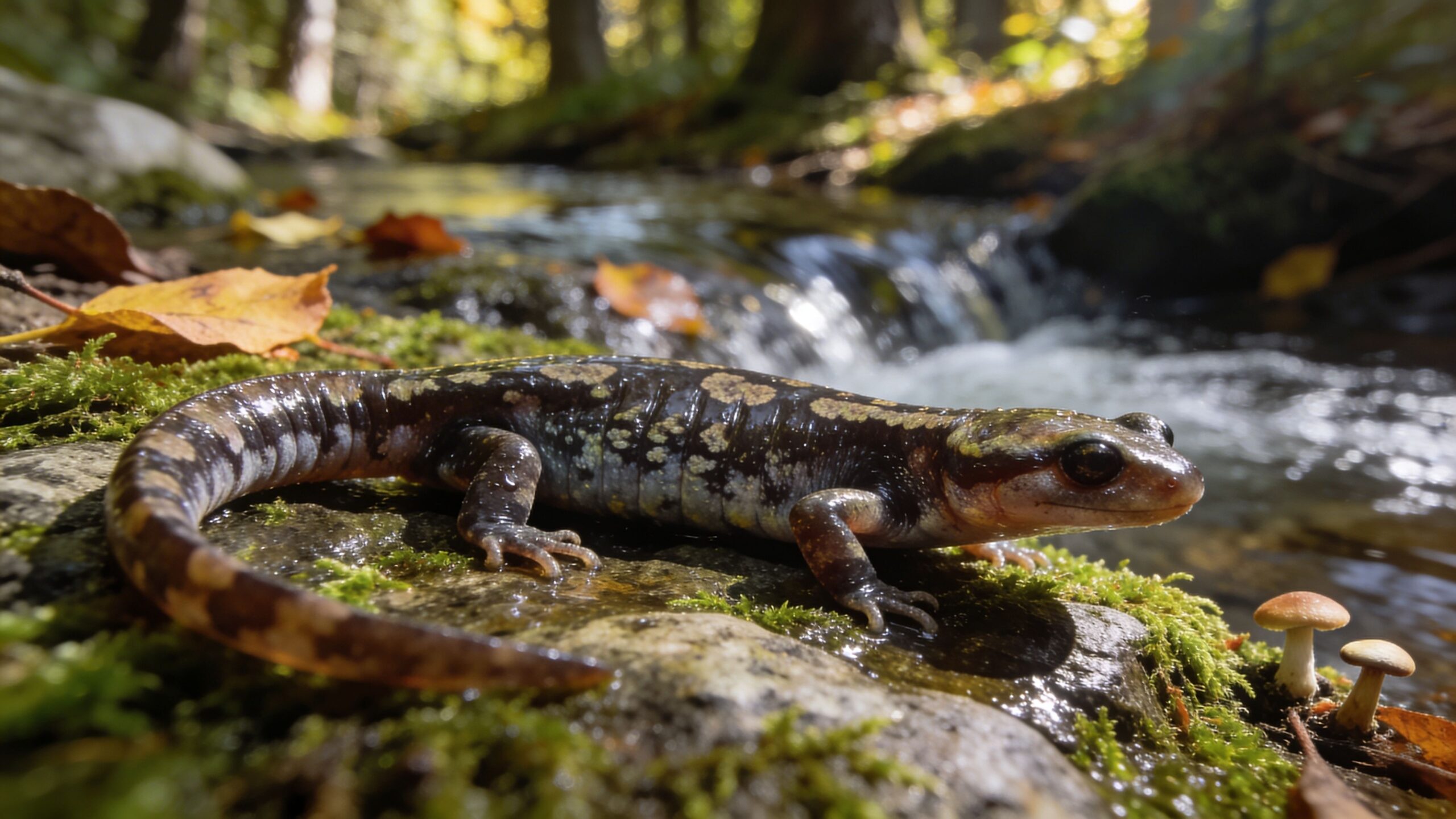
Masters of Breathing Without Lungs
Hidden beneath fallen logs, tucked inside damp rock crevices, and quietly navigating moss-covered forests lives one of the most remarkable groups of amphibians on Earth. Lungless salamanders, members of the family Plethodontidae, have achieved something that seems biologically impossible at first glance. They live their entire lives without lungs. Instead of breathing air the way most amphibians do, they rely entirely on their skin and the delicate lining of their mouths to absorb oxygen directly from their environment. This unusual adaptation has allowed them to evolve into one of the most successful and diverse salamander families in the world. These animals may appear modest at first glance, but their ecological importance and evolutionary innovation are extraordinary. Lungless salamanders inhabit forests, mountains, caves, and streams across the Americas and parts of Europe. Many species are incredibly small, living secretive lives beneath leaves or stones, yet their numbers can be staggering in healthy ecosystems. In some forests they are among the most abundant vertebrates, quietly controlling insect populations and helping maintain ecological balance. Their story is one of subtle power, remarkable adaptation, and biological ingenuity.
A: Start with body shape and habitat, then use color, markings, size, and behavior as confirmation.
A: Because Lungless Salamanders has its own mix of structure, habitat, feeding, and comparison clues.
A: Compare it with the nearest parent, child, or lookalike pages before treating one trait as final.
A: No. Age, season, lighting, region, and posture can all change the first impression.
A: Look for the setting that explains the animal: water, cover, vegetation, substrate, altitude, reef, burrow, branch, or open ground.
A: The exact diet depends on the animal, but mouth shape, movement, and habitat usually reveal the feeding strategy.
A: Many animals change size, color, pattern, diet, risk, or habitat between young and adult stages.
A: Use the photo to check eye position, body outline, limbs or fins, texture, posture, and surrounding habitat.
A: Yes. Every animal affects food webs, habitat structure, competition, nutrient movement, or predator-prey balance in some way.
A: It should connect the animal's visible traits to how it survives, moves, feeds, and fits the taxonomy.
The Unique Biology of Lungless Salamanders
Lungless salamanders belong to the amphibian family Plethodontidae, the largest salamander family in the world. What makes them unique is exactly what their name suggests: they have completely lost their lungs through evolution. Instead, oxygen diffuses through their moist skin and the lining of their mouth and throat. This method of respiration requires constant moisture, which is why lungless salamanders almost always inhabit humid environments where their skin can remain wet enough to allow oxygen exchange.
This breathing method shapes nearly every aspect of their biology. Their bodies tend to be slender, allowing oxygen to pass efficiently through the skin. Many species have narrow heads and streamlined forms suited for slipping through soil, moss, or leaf litter. Their survival depends heavily on cool temperatures and high humidity, which is why lungless salamanders are often most active at night or during rainy weather. In these conditions they emerge to hunt small invertebrates, moving quietly through the forest floor like miniature predators.
Woodland Lungless Salamanders
The most familiar members of this group live in temperate forests where the ground remains damp and shaded for much of the year. Woodland lungless salamanders are masters of camouflage, blending perfectly with bark, soil, and decaying leaves. The red-backed salamander is one of the most iconic species in this group, easily recognized by the stripe that runs down its back. Despite its small size, it plays a major role in forest ecosystems by feeding on insects, mites, and other tiny creatures. These salamanders rarely travel far from their territories, often living their entire lives within a small patch of forest floor. Many defend tiny home ranges beneath logs or stones where they shelter from predators and dry conditions. Because they are so abundant in some forests, scientists believe lungless salamanders may influence nutrient cycles by regulating populations of soil invertebrates. Their quiet presence beneath the forest floor makes them a hidden but powerful ecological force.
Streamside and Mountain Salamanders
Another branch of lungless salamanders has adapted to life near cold mountain streams and rushing rivers. These species tend to have more streamlined bodies and strong limbs that allow them to cling to rocks in fast-moving water. Their skin patterns often resemble speckled stones or wet gravel, making them almost invisible in their natural environment.
Species like the two-lined salamander illustrate this lifestyle perfectly. They inhabit clear streams where they hunt small aquatic insects and larvae. Because they depend on clean, oxygen-rich water, these salamanders are highly sensitive to pollution and habitat disturbance. Their presence often signals that a stream ecosystem is healthy and functioning well, making them valuable indicators for conservation scientists.
Cave-Dwelling Lungless Salamanders
Some lungless salamanders have taken adaptation even further by evolving to live inside caves and underground environments. In these dark worlds, vision becomes far less important than touch and chemical sensing. Many cave salamanders develop pale or translucent skin, and some species gradually lose pigmentation over generations. The Texas blind salamander and several other cave-dwelling relatives demonstrate how extreme these adaptations can become. Living in underground waterways, they navigate through darkness using heightened senses of vibration and smell. These animals remind us that salamanders are capable of thriving in places where most vertebrates would struggle to survive. Their existence expands our understanding of how life adapts to the most unusual environments on Earth.
Tropical Lungless Salamanders
While many people associate salamanders with cool forests, lungless salamanders have also colonized tropical regions. In Central and South America, these amphibians inhabit cloud forests, mountain jungles, and humid valleys where rainfall is frequent and temperatures remain stable. Tropical lungless salamanders often display vibrant colors and intricate patterns that rival some of the most colorful frogs.
Many tropical species live high in vegetation, climbing leaves and branches in search of insects. Others hide inside bromeliads or moist tree cavities where water collects. This arboreal lifestyle is unusual for salamanders but demonstrates the flexibility of the lungless salamander body plan. In these tropical ecosystems, they fill ecological niches similar to those occupied by small lizards or frogs.
Arboreal Salamanders of the Forest Canopy
Some lungless salamanders have adapted specifically to life above the forest floor. Arboreal species use long limbs and specialized toe structures to grip bark and leaves while climbing through vegetation. Their movements are careful and deliberate, allowing them to navigate branches and tree trunks in search of prey. The wandering salamander of North America is one of the most fascinating examples of this lifestyle. It lives high in redwood forests where moisture remains trapped in the canopy. These salamanders glide short distances by spreading their limbs and flattening their bodies, allowing them to control their descent from tree trunks. Their ability to occupy vertical forest habitats shows just how versatile lungless salamanders can be.
The Ecological Importance of Lungless Salamanders
Despite their quiet lifestyles, lungless salamanders are vital players in many ecosystems. By feeding on insects, mites, worms, and other invertebrates, they help regulate populations that might otherwise grow unchecked. In forests where they are abundant, salamanders can influence how nutrients move through the soil and leaf litter.
They also serve as prey for a variety of animals including birds, snakes, mammals, and larger amphibians. This position in the food web connects them to many other species, reinforcing their ecological importance. Because they are sensitive to environmental changes, lungless salamanders often provide early warnings about habitat damage, pollution, or climate shifts that might threaten broader ecosystems.
Why Lungless Salamanders Fascinate Scientists
One reason scientists study lungless salamanders so closely is their extraordinary evolutionary success. The Plethodontidae family includes hundreds of species and continues to diversify in different environments. Their ability to survive without lungs has opened ecological opportunities that other amphibians cannot easily exploit. Researchers are also fascinated by their developmental biology, sensory systems, and reproductive strategies. Many species engage in complex courtship behaviors involving chemical signals and elaborate mating rituals. Some even exhibit parental care, guarding eggs until they hatch. These behaviors reveal a surprising level of sophistication in animals that many people rarely notice.
A Hidden World Waiting to Be Explored
Lungless salamanders represent one of the most intriguing branches of amphibian life. They breathe through their skin, navigate dark forests and underground rivers, and quietly shape the ecosystems around them. Their diversity stretches from tiny woodland species to cave dwellers and tree climbers, each adapted to its own ecological niche.
Exploring the individual groups within lungless salamanders reveals an astonishing array of lifestyles and evolutionary strategies. Each subcategory offers its own stories of survival, adaptation, and ecological importance. By diving deeper into these remarkable animals, readers can uncover a hidden world of amphibians that thrives quietly beneath leaves, stones, and forest shadows across the globe.
Animal Product Reviews
Dive into Animal Streets’ Animal Product Reviews — your guide to the best gear, gifts, books, and gadgets inspired by the animal kingdom. From land-roaming lions to ocean-gliding whales, from household pets to prehistoric giants, we explore top-rated products for enthusiasts, educators, and animal lovers alike. Whether you’re shopping for toys, decor, field gear, or fun collectibles, we’ve sniffed out the best so you can discover it all in one wild place!