
A river giant with an ancient name
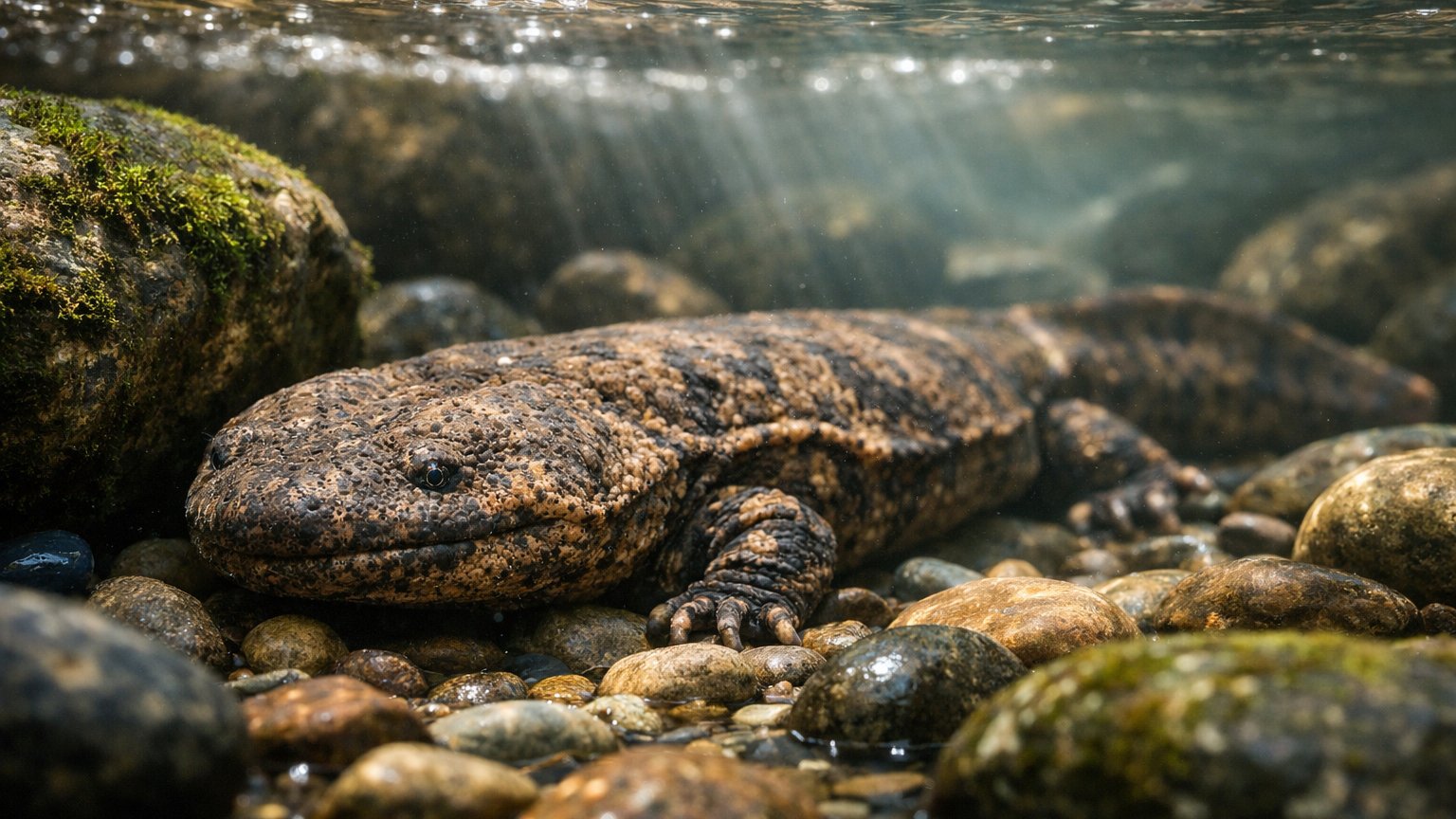
The Japanese giant salamander, Andrias japonicus, is one of the most remarkable amphibians on Earth and one of Japan’s most distinctive native animals. It belongs to an ancient family of salamanders that includes some of the largest amphibians ever known, and it has a look that feels almost prehistoric at first glance. With its broad flattened head, wrinkled skin, tiny eyes, and heavy body, it appears less like a typical salamander and more like a survivor from another era. Yet despite its dramatic appearance, it is a real and living part of modern freshwater ecosystems in Japan. For general readers, it offers the rare combination of scientific importance, natural mystery, and visual fascination that makes an animal instantly memorable. What makes this species especially engaging is the way it combines size, secrecy, and evolutionary history. The Japanese giant salamander is not simply a large amphibian; it is one of the world’s largest salamanders and one of the few surviving members of a very old lineage. It lives almost entirely in cool, flowing freshwater and spends much of its life hidden under rocks, inside streamside cavities, or tucked into dark underwater shelters. Because it is elusive and mostly active at night, many people in Japan can live near its habitat and still never see one in the wild. That hidden life has helped give the species an aura of quiet legend as well as scientific significance.
A: No. It is one of the largest, but the Chinese giant salamander is larger.
A: It is native to Japan, especially parts of Honshu, Shikoku, and Kyushu.
A: It is almost entirely aquatic and spends nearly all of its life in water.
A: It feeds on fish, insects, crustaceans, worms, and other small aquatic animals.
A: It is not considered a threat to humans and usually avoids contact.
A: The folds increase surface area and help with oxygen absorption.
A: It is mostly active at night.
A: It is a well-known native species and is legally protected as a natural monument.
A: Yes. After spawning, the male guards the nest while the eggs develop.
A: Its great size, ancient lineage, hidden lifestyle, and unusual appearance make it unforgettable.
Built for cold water and silence
One reason the Japanese giant salamander captures so much attention is its size. The Smithsonian’s National Zoo says it can reach about 5 feet, or 1.5 meters, in length and weigh up to 55 pounds, while Britannica notes that the species can grow to roughly 1.7 meters, or 5.6 feet, making it one of the largest salamanders in the world. Only the Chinese giant salamander is clearly larger among living salamanders, so the Japanese species holds an unusually high place in the amphibian world. That large body is not sleek in the way of a fish or graceful in the way of many frogs. Instead, it is dense, low, muscular, and designed for a life close to the streambed.
Its body shape reveals how specialized it is for aquatic living. The head is broad and flat, the eyes are very small, the limbs are short but sturdy, and the tail is compressed in a way that helps with movement through water. The skin is loose and wrinkled rather than smooth and tight, and those folds are not just a visual oddity. In giant salamanders, that increased skin surface helps with gas exchange, which is especially useful in cool, oxygen-rich streams. The overall effect is an animal that does not look fast or elegant, but is perfectly suited to a slow, bottom-dwelling, highly efficient lifestyle.
A species found only in Japan
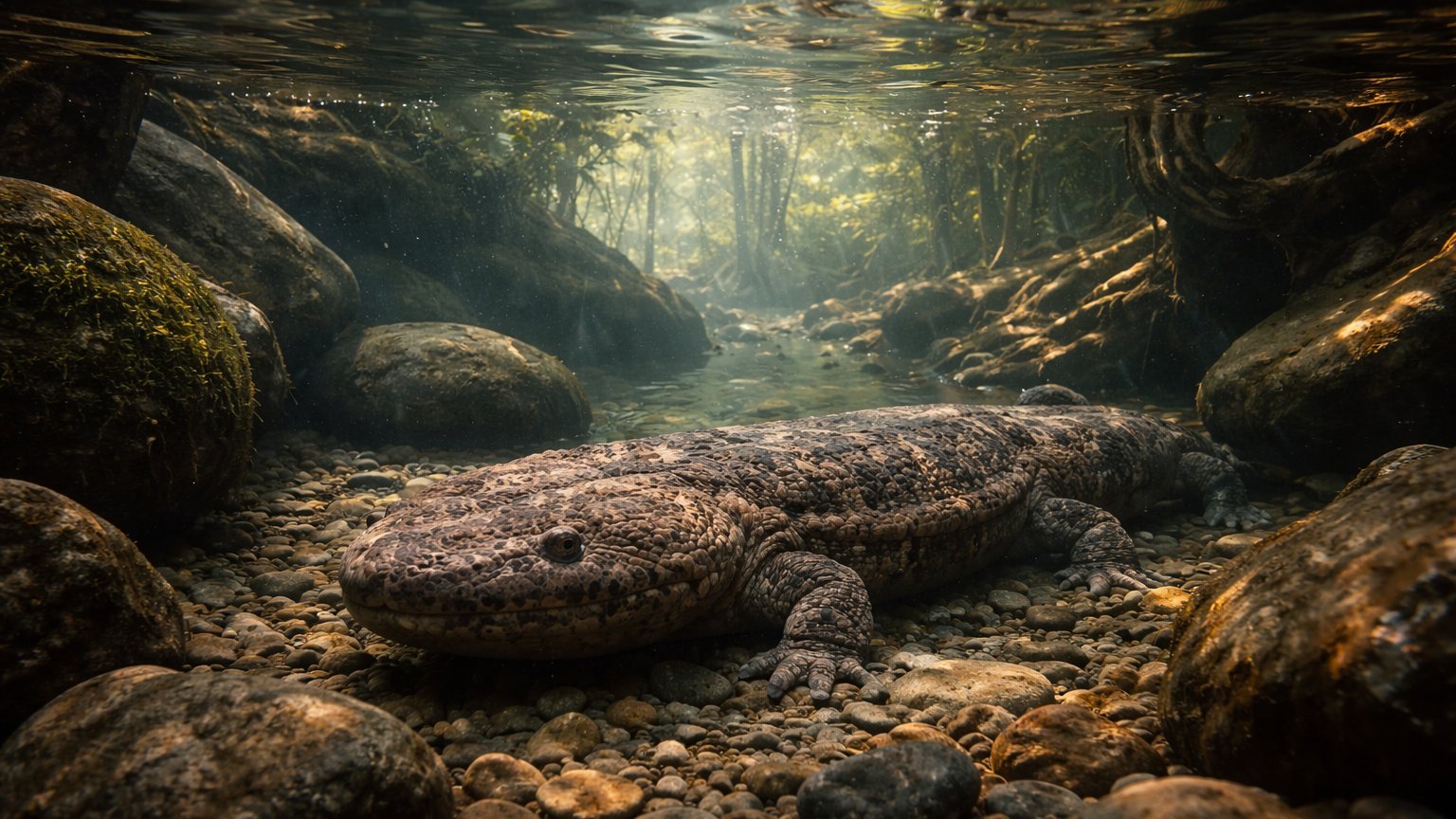
The Japanese giant salamander is endemic to Japan, meaning it is naturally found nowhere else. Modern sources describe it as occurring on three of Japan’s main islands: Honshu, Shikoku, and Kyushu, with the Honshu distribution concentrated in the southwest. That limited range immediately makes the animal more interesting from a biogeographic point of view because it ties the species tightly to Japanese landscapes, rivers, and natural history. It is not a widespread amphibian that happens to occur in Japan among many other places. It is fundamentally part of Japan’s native freshwater wildlife. Within that range, the animal favors clear, cool, flowing water, from relatively large rivers to much smaller tributary streams. AmphibiaWeb describes habitats with rocky or gravel bottoms and notes that individuals conceal themselves in rocky caverns or burrows at the water’s edge. These are not warm, stagnant ponds or marshes. They are oxygen-rich running waters, often in mountain or upland environments, where current, stone cover, and water quality all matter. This habitat preference explains much about the species, from its body form to its behavior and its sensitivity to environmental change.
A life spent mostly out of sight
For such a large animal, the Japanese giant salamander is surprisingly hard to spot. It is largely nocturnal and spends much of the day hidden in submerged shelters rather than out in open water. Its coloration helps with that secrecy, since the body usually shows mottled brown, gray, or darker tones that blend naturally with rock, shadow, and streambed debris. In moving water and low light, this camouflage can make even a very large individual nearly invisible. The animal’s stillness adds to the effect, because it often relies on remaining motionless until it needs to move or feed.
Its hidden routine is part of what makes it feel so ancient and mysterious. Many familiar amphibians, such as frogs, announce themselves loudly, move often, or gather conspicuously in breeding seasons. The Japanese giant salamander is different. It lives in a world of under-rock darkness, nighttime movement, and close contact with water and stone. Even when present in a stream, it may leave behind almost no obvious sign to a casual observer. That secretive way of life has shaped not only how the species survives, but also how humans imagine it.
How it senses the world underwater
The Japanese giant salamander does not depend on sharp vision in the way birds or many mammals do. Its eyes are small, and its world is often dark, silty, or hidden beneath stones and flowing current. Instead, giant salamanders are adapted to detect changes in their environment through other sensory systems, especially movement and water disturbance. This is one reason they can remain effective predators in conditions where visual hunting would be difficult. In essence, they read the stream through touch-like environmental cues. That sensory strategy matches the broader theme of the species: efficiency instead of flash. A large, slow-moving, mostly nocturnal amphibian does not need to chase prey over long distances if it can detect motion nearby and react with precision. Its body is built for holding position on the bottom, staying hidden, and responding quickly when something edible comes within range. This kind of predator does not dominate through speed but through patience, sensitivity, and timing. The result is a hunting style that feels less dramatic on the surface and more impressive the more closely one studies it.
Feeding like an ambush specialist
Japanese giant salamanders eat animal prey, and sources commonly describe diets that can include fish, insects, crustaceans, worms, and other small aquatic animals. Because they live on the bottom and often remain concealed, they are not active pursuit hunters in the style of a trout or otter. Instead, they function as ambush predators, waiting for prey to come close enough to seize. This strategy fits with their broad head and strong jaws, which allow them to capture food effectively without sustained chase. Their feeding behavior reflects a low-energy but highly workable design for stream life.
A large amphibian in cold water also tends to operate on a slower metabolic pace than a warm-blooded animal of similar size. That means the Japanese giant salamander does not need constant feeding in the way many birds or mammals do. It can remain still for long periods, then respond rapidly when prey appears. In ecological terms, this makes it an important mid-to-upper-level aquatic predator in the systems where it lives. It is not simply a curiosity on the river bottom; it is part of how those freshwater food webs are structured.
Reproduction in underwater dens
The breeding cycle of the Japanese giant salamander adds another layer to its appeal because it involves careful use of underwater dens and a clear parental role for males. The Smithsonian notes that during the breeding season, multiple females may enter a den and spawn with the male, with females typically laying about 400 to 600 eggs. After the eggs are laid and fertilized, the females leave and the male remains to guard the developing eggs. That kind of nest attendance is especially interesting in an amphibian, since many people assume amphibian reproduction is generally less guarded and more exposed. This reproductive pattern also highlights how important suitable stream structure is to the species. Breeding is not just about having clean water. It also depends on having the right physical spaces, including cavities and protected dens where eggs can be laid and defended. When readers think about the Japanese giant salamander, it helps to picture not only the animal itself but the architecture of the stream around it: rocks, current, submerged openings, and quiet hidden chambers. The species is tied to habitat in a very physical, immediate way. Remove the structure, and much of the life cycle becomes harder to complete.
An ancient survivor in evolutionary terms
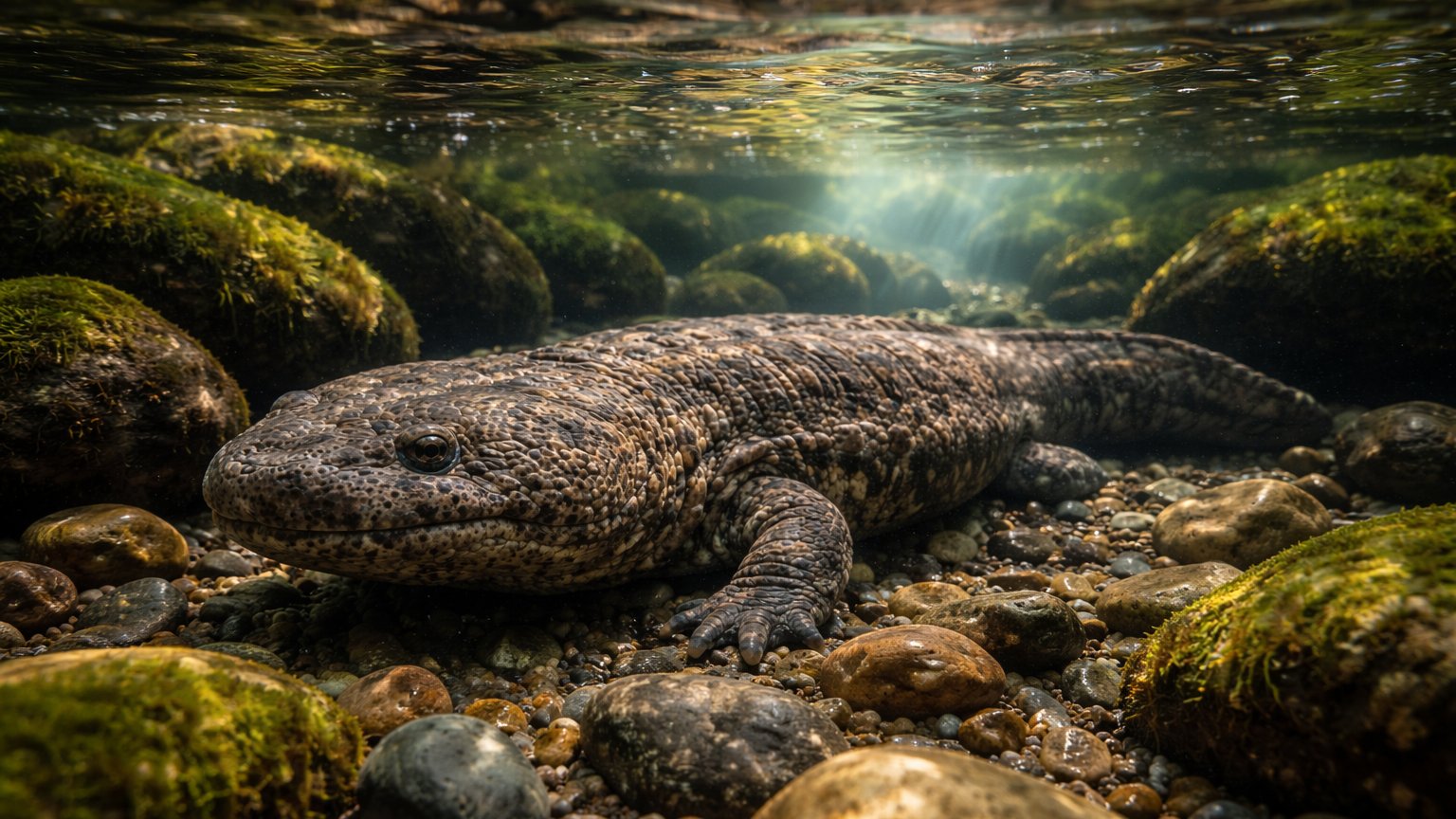
The Japanese giant salamander belongs to the family Cryptobranchidae, a group that is often described as ancient or primitive in evolutionary terms. That language does not mean the species is poorly adapted or somehow unfinished. It means that the lineage preserves body plans and traits with deep roots in amphibian history, offering a window into old branches of vertebrate evolution. Giant salamanders are sometimes described as living reminders of much earlier eras because their general form and ecology differ so strongly from the frogs and salamanders many people know better. In public imagination, that connection to deep time is part of their enduring power.
This evolutionary background matters because it gives the species scientific weight beyond its visual appeal. To study Andrias japonicus is to study an animal that can help illuminate long-term amphibian evolution, aquatic adaptation, and the persistence of ancient lineages in modern environments. It also reminds readers that not all evolutionary success looks new or flashy. Sometimes a very old design continues because it works. The Japanese giant salamander is one of those cases where survival itself becomes part of the fascination.
A place in Japanese culture and identity
The Japanese giant salamander is not only biologically notable; it also carries cultural importance in Japan. It is widely known by the Japanese name ōsanshōuo, and regional names such as hanzaki have their own local history and folklore. Sources describe the species as protected as a Special Natural Monument in Japan since 1952, reflecting cultural as well as scientific value. That status is a sign that the animal is viewed not simply as wildlife, but as part of the nation’s natural heritage. This cultural role helps explain why the species appears in local stories, educational efforts, and place-based identity. Animals that remain hidden in daily life can still become strong symbols, especially when they are unique, ancient-looking, and tied to a specific landscape. The Japanese giant salamander fits that pattern almost perfectly. It belongs to rivers and mountains, but also to memory, folklore, and civic pride in some communities. For readers, that makes it more than a biological subject; it becomes part of a broader story about how nations understand and value their native species.
Quiet ecological importance
In ecological terms, the Japanese giant salamander matters because it is both a predator and a sign of freshwater habitat quality. AmphibiaWeb and other sources emphasize its association with clear, cool, running water. Species with that kind of habitat requirement often become useful indicators, since their condition can reflect the condition of the streams they inhabit. If an animal needs clean, oxygen-rich, structurally complex water to survive and reproduce, its presence says something important about the ecosystem. It tells us the river is doing more than simply carrying water downhill.
The salamander’s ecological role is also practical. By feeding on aquatic animals and occupying a major place in stream food webs, it participates in the balance of those systems. It is not the only important species in its habitat, of course, but it is a memorable one that helps readers grasp how specialized freshwater communities can be. Rivers are often imagined as simple channels, yet animals like this reveal them as layered environments full of niches, shelters, feeding strategies, and evolutionary tradeoffs. The Japanese giant salamander is one of the clearest examples of that hidden complexity.
A measured look at conservation
A toned-down conservation discussion still has to acknowledge that the species faces pressure. The 2024 Frontiers paper describes the Japanese giant salamander as listed as Vulnerable on the IUCN Red List and notes a long period of population decline, while modern summaries also point to habitat fragmentation and other environmental stressors. This does not erase the animal’s resilience, but it does show that very old lineages can still be vulnerable in rapidly changing conditions. Freshwater species are often especially exposed because they depend on connected, functioning river systems rather than isolated pockets of habitat. For a large, stream-specialized amphibian, small changes in flow, water quality, or river structure can matter a great deal. At the same time, the story is not simply one of decline. The species receives legal protection in Japan, draws sustained scientific attention, and serves as a flagship for stream conservation in some places. Research, field surveys, and breeding-related work all show that people continue to invest effort in understanding and protecting it. That makes the Japanese giant salamander a useful example of how conservation can be thoughtful rather than alarmist. It is possible to appreciate the animal, understand the pressures it faces, and still present the topic in a calm, grounded way.
Why general readers find it unforgettable
Part of the Japanese giant salamander’s appeal is that it overturns expectations. Many people think of salamanders as small, delicate, woodland animals hiding under logs after rain. This species is something else entirely: huge, aquatic, ancient-looking, and tied to mountain streams. It is at once unfamiliar and deeply real, which gives it the rare quality of feeling almost mythical without leaving the realm of fact. Animals that do that tend to stay with readers long after they finish an article.
It is also wonderfully teachable. Through one species, readers can learn about endemism, freshwater ecology, sensory adaptation, reproduction, habitat structure, cultural protection, and evolutionary history. Few animals offer so many entry points while still remaining accessible to a general audience. The Japanese giant salamander invites curiosity because it looks strange, but it rewards curiosity because its biology is rich and coherent. The more you learn about it, the more it becomes not just an odd amphibian, but a compelling guide to how life can adapt to a specific place over an immense span of time.
The lasting impression of Andrias japonicus
In the end, the Japanese giant salamander stands out because it combines scale, secrecy, and antiquity in a way few animals can. It is large enough to surprise, specialized enough to intrigue, and old enough in evolutionary terms to stir the imagination. Yet it is not a fantasy creature or a relic trapped in a museum case. It is a living amphibian, native to Japan, still moving through cold streams, still hiding beneath stones, and still carrying forward a lineage that reaches deep into the past. That alone is enough to make it one of the most fascinating amphibians a general reader is likely to encounter. Its story also has a broader meaning. The existence of Andrias japonicus reminds us that some of the world’s most extraordinary animals are not always the loudest, fastest, or most visible. Sometimes they are the quiet specialists, shaped by one kind of habitat over immense stretches of time, and still present if we take the time to understand them. The Japanese giant salamander rewards that attention. It is a species that makes rivers feel deeper, history feel longer, and the natural world feel more surprising than it first appears.
Animal Product Reviews
Dive into Animal Streets’ Animal Product Reviews — your guide to the best gear, gifts, books, and gadgets inspired by the animal kingdom. From land-roaming lions to ocean-gliding whales, from household pets to prehistoric giants, we explore top-rated products for enthusiasts, educators, and animal lovers alike. Whether you’re shopping for toys, decor, field gear, or fun collectibles, we’ve sniffed out the best so you can discover it all in one wild place!