What Defines a True Frog
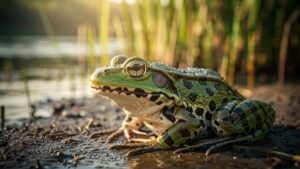
True frogs belong to a distinct group of amphibians characterized by smooth, moist skin and long hind legs built for jumping and swimming. Their bodies are streamlined, allowing them to move efficiently through water while remaining agile on land. Most species have webbed feet, strong muscles, and excellent vision tuned to detect movement. Unlike toads, true frogs rely less on toxins and more on speed and camouflage to survive. Their permeable skin plays a vital role in respiration and hydration, tying them closely to clean water and humid environments.
The Amphibian Advantage
As amphibians, true frogs occupy a unique biological position between aquatic and terrestrial life. Their life cycle typically begins in water as tadpoles, breathing through gills and feeding on algae and organic matter. Through metamorphosis, they undergo one of nature’s most dramatic transformations, developing lungs, limbs, and adult feeding strategies. This dual existence allows true frogs to exploit multiple ecological niches, reducing competition and increasing survival across diverse habitats.
Aquatic and Semi-Aquatic Frogs
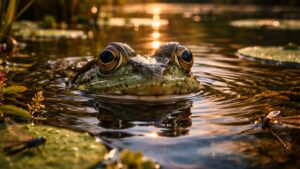
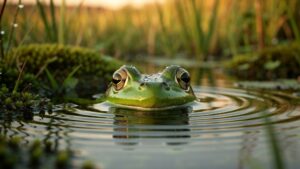
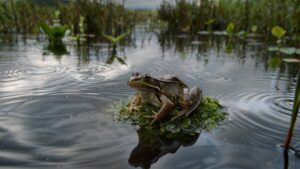
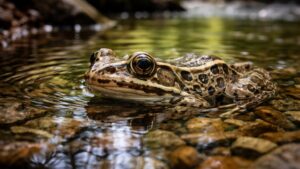
Many true frogs spend much of their lives in or near water, thriving in ponds, lakes, rivers, and marshes. These species are powerful swimmers, using webbed feet to propel themselves with speed and precision. Their eyes sit high on the head, allowing them to see above the water while remaining mostly submerged. Aquatic true frogs often feed on insects, small fish, and invertebrates, helping regulate populations within freshwater ecosystems.
Pond and Wetland Frogs
Pond-dwelling true frogs are among the most familiar amphibians to humans. They breed in still or slow-moving water, where their calls echo across wetlands during spring and summer. These frogs play a critical role in wetland food webs, consuming vast numbers of insects while serving as prey for birds, reptiles, and mammals. Their presence often indicates balanced water conditions and healthy vegetation.
River and Stream Frogs
True frogs that inhabit flowing water environments are adapted for life in currents. Their bodies are often flatter, with strong limbs that help them anchor to rocks and navigate swift streams. These species rely on clean, oxygen-rich water and are especially sensitive to pollution and sedimentation. Their survival is closely tied to intact watersheds and undisturbed riparian zones.
Forest-Edge and Meadow Frogs
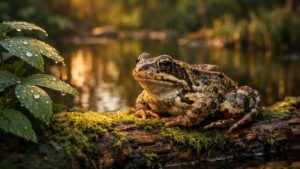
Some true frogs thrive at the edges of forests and open meadows, moving between water and land as conditions change. These species often forage far from breeding sites, hunting insects among grasses and leaf litter. Their coloration blends with surrounding vegetation, providing camouflage against predators. Seasonal migrations between feeding and breeding areas are common, demonstrating their strong spatial awareness and environmental memory.
Tropical True Frogs
In tropical regions, true frogs reach extraordinary levels of diversity. Rainforest species may breed year-round, taking advantage of abundant moisture and stable temperatures. Many tropical true frogs exhibit complex behaviors, including territorial calls, parental care, and specialized breeding strategies. Their roles as insect predators are especially important in ecosystems where insect populations grow rapidly.
Feeding Strategies and Hunting Behavior
True frogs are opportunistic predators, relying on keen eyesight and lightning-fast reflexes. They use sticky tongues to capture prey in fractions of a second, feeding on insects, spiders, worms, and other small animals. Larger species may consume fish, other amphibians, or even small mammals. By controlling insect populations, true frogs contribute directly to ecosystem stability and human well-being.
Communication and Vocalization
The calls of true frogs are among their most defining features. Males vocalize to attract mates, establish territory, and synchronize breeding events. Each species produces distinct sounds, creating complex soundscapes around wetlands and waterways. These calls are not just mating signals but indicators of environmental health, as silence often signals ecological disruption.
Predators and Survival Tactics
Despite their agility, true frogs face numerous predators. Birds, snakes, mammals, and fish all rely on frogs as a food source. To survive, true frogs employ camouflage, rapid escape responses, and in some cases startling behaviors like sudden leaps into water. Their skin may also produce mild defensive secretions, deterring predators without relying on heavy toxins.
Seasonal Rhythms and Hibernation
In temperate regions, true frogs follow strong seasonal cycles. As temperatures drop, many species hibernate in mud, leaf litter, or underwater, slowing their metabolism to survive winter. In warmer months, they emerge to feed, grow, and reproduce. These cycles align frog activity with insect availability and optimal environmental conditions.
Ecological Importance of True Frogs
True frogs occupy a central position in food webs. As predators, they regulate insect populations that might otherwise overwhelm ecosystems. As prey, they transfer energy to higher trophic levels. Their sensitivity to environmental change makes them reliable indicators of water quality, climate shifts, and habitat health.
Conservation Challenges
True frogs face increasing threats from habitat loss, pollution, climate change, invasive species, and disease. Wetland destruction and water contamination directly impact their survival. Conservation efforts focused on habitat protection, clean water initiatives, and disease management are essential to maintaining frog populations worldwide.
Cultural and Scientific Significance
Throughout history, true frogs have appeared in folklore, art, and scientific research. They have contributed to advances in developmental biology, physiology, and ecology. Their life cycles continue to inspire curiosity and deepen understanding of how animals adapt to changing environments.
Exploring the World of True Frogs
True frogs represent adaptability, balance, and ecological connection. From quiet backyard ponds to remote tropical rivers, their presence shapes the living world in subtle but powerful ways. Exploring individual sub-categories reveals even deeper stories of survival, specialization, and resilience. Let this page be the gateway to discovering the many forms, behaviors, and habitats that define true frogs across the globe.