
The Hidden Amphibian Beneath the Soil
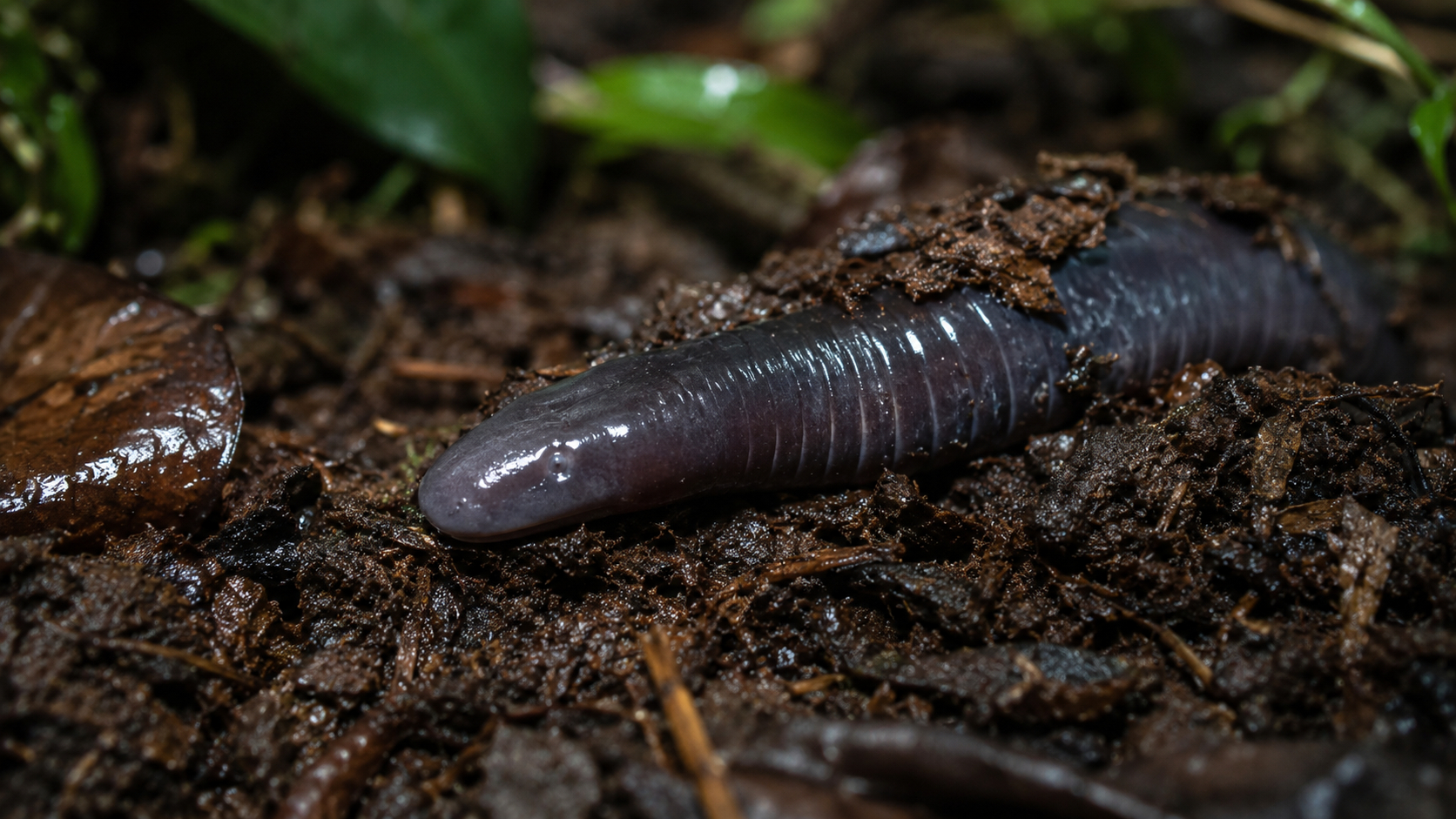
The common caecilian, often associated with the scientific name Siphonops annulatus, is one of the most fascinating animals most people have never seen. At first glance, it may look like an earthworm, eel, or small snake, but it is actually an amphibian, related more closely to frogs and salamanders than to reptiles or worms. This unusual creature belongs to a group called caecilians, a lineage of limbless amphibians that spend much of their lives hidden underground or in wet, secretive places. The common caecilian is also widely known as the ringed caecilian, a name inspired by the circular grooves that wrap around its body like natural bands. It is a remarkable example of how life can evolve in quiet, low-light worlds that most humans rarely notice. For general readers, the common caecilian is especially interesting because it challenges the familiar idea of what an amphibian should look like. Many people picture amphibians as frogs leaping near ponds or salamanders crawling under logs, but caecilians show that amphibians can also be powerful burrowers with smooth bodies, reduced eyes, sensory tentacles, and unusual parenting behaviors. They are built for a life of touch, scent, pressure, and moisture rather than bright vision and open-air movement. Their story takes place below fallen leaves, inside loose soil, and beneath the surface of tropical landscapes. In that hidden world, the common caecilian is not strange at all; it is beautifully specialized.
A: No, it is a limbless amphibian related to frogs and salamanders.
A: It is widely associated with the scientific name Siphonops annulatus.
A: It lives in parts of South America, often in moist soil, forests, savannas, gardens, and leaf litter.
A: It lives mostly underground, where touch, scent, and chemical sensing are more useful than sharp vision.
A: It eats small soil-dwelling animals such as worms, insects, larvae, and other invertebrates.
A: No, caecilians are naturally limbless amphibians adapted for burrowing.
A: It is not considered dangerous to people and is best left undisturbed in its habitat.
A: Its body has circular grooves called annuli that create a ringed appearance.
A: Yes, mothers show unusual parental care, including nourishment after the young hatch.
A: It is a specialized wild amphibian with sensitive habitat needs, so it is better appreciated through education and conservation rather than casual pet keeping.
A Body Built Like a Living Tunnel Machine
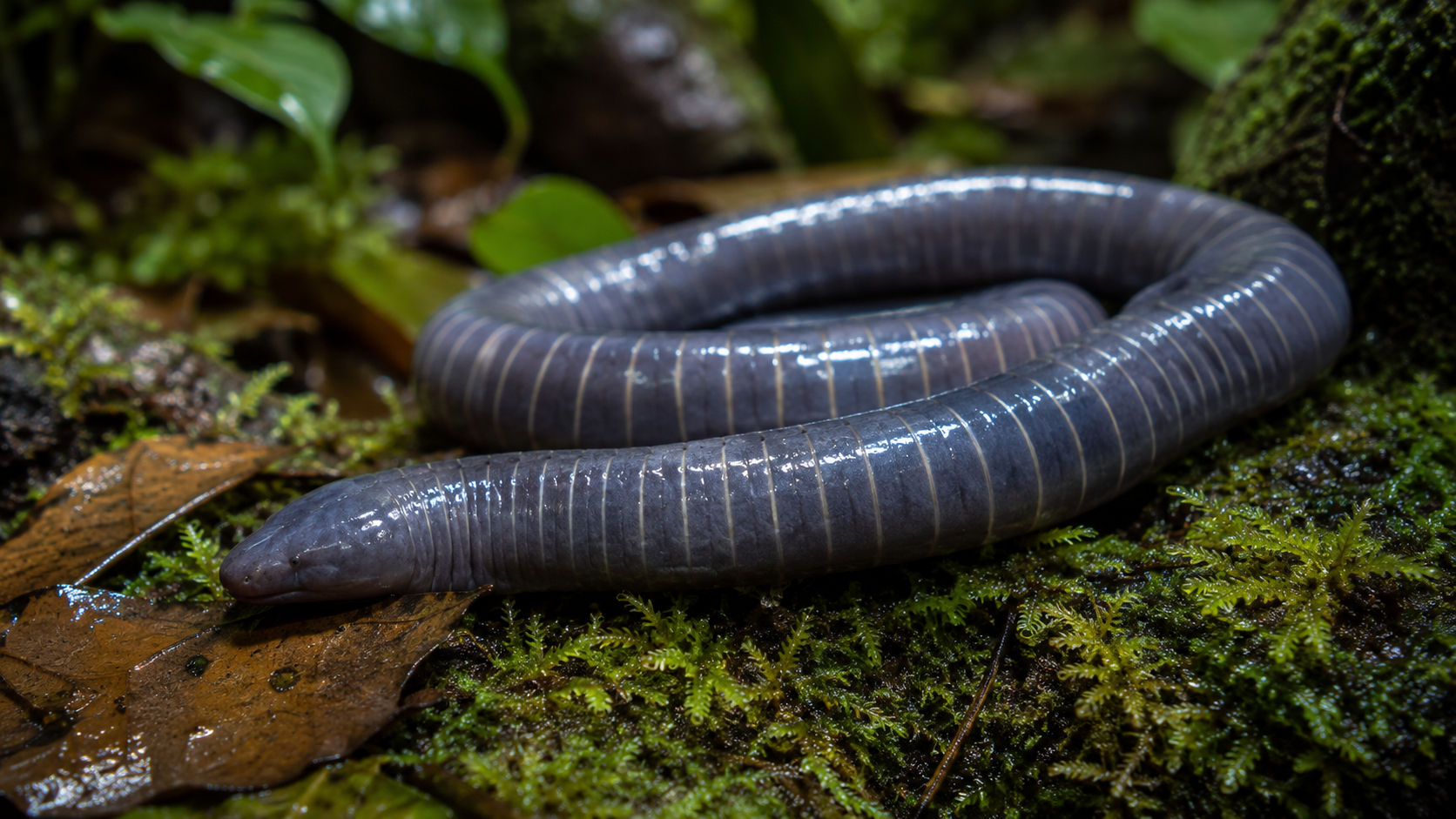
The common caecilian has a long, cylindrical body with no legs, giving it a sleek shape that helps it move through soil. Its body is marked by ring-like folds called annuli, which can make it look segmented even though it is a vertebrate with an internal skeleton. Its skin is typically dark, often bluish-gray, slate, or nearly black, with lighter lines that may outline the body rings. This smooth, glossy skin is important because, like other amphibians, caecilians rely partly on moist skin for gas exchange and general body function. In a damp underground environment, that skin becomes both protection and a sensitive connection to the world.
The head of the common caecilian is compact and sturdy, shaped less for biting display and more for pushing through earth. Its skull is strongly built compared with many surface-dwelling amphibians, helping it press, wedge, and force its way into soft ground. Its eyes are tiny and often difficult to see, because sight is less useful in darkness than touch and chemical sensing. Near the head, caecilians have small sensory tentacles, specialized organs that help them explore their surroundings and detect chemical cues. These features make the common caecilian a reminder that evolution does not always move toward flashiness; sometimes it moves toward quiet efficiency.
Where the Common Caecilian Lives
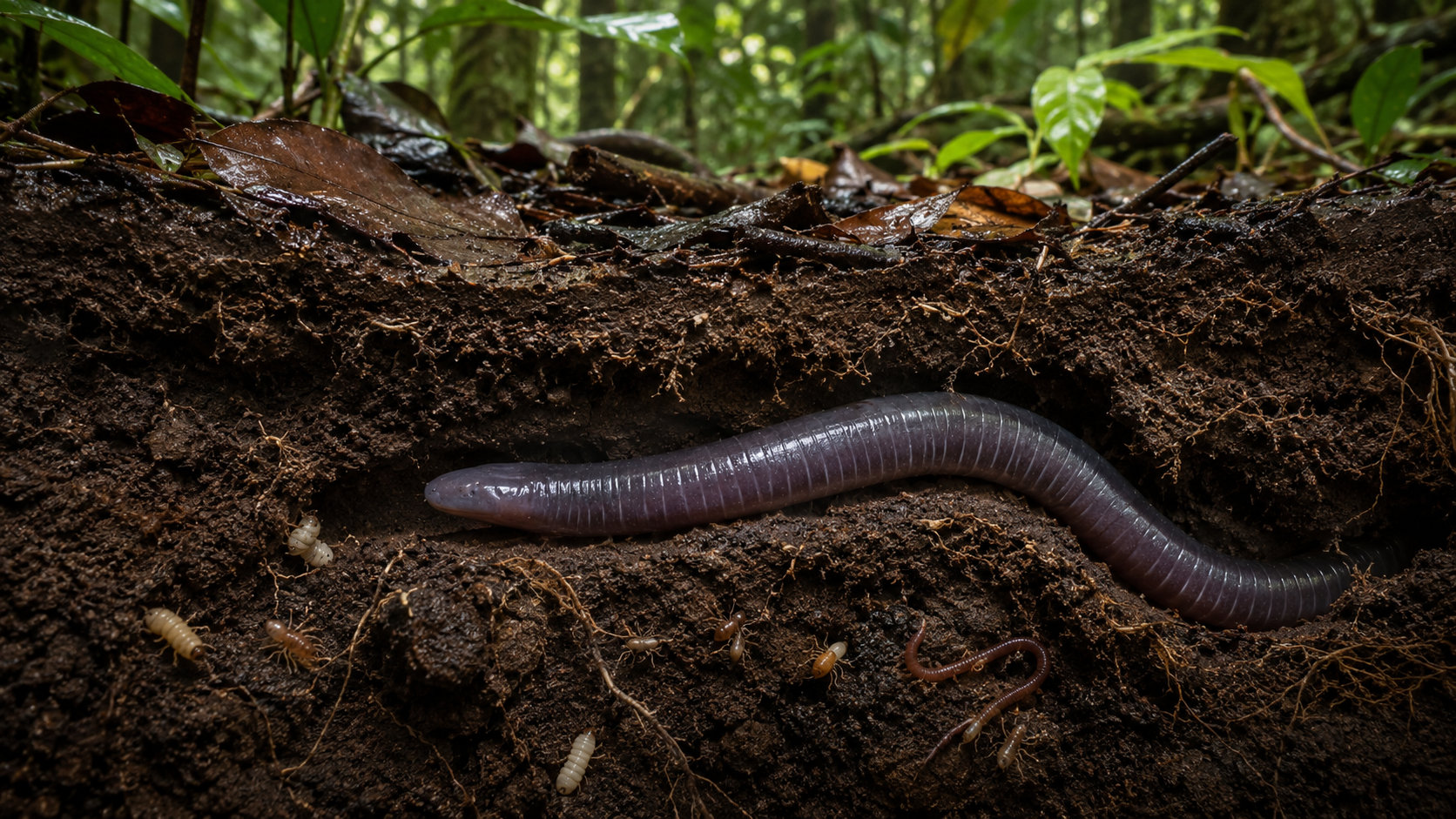
The common caecilian is native to South America and is reported across a broad region east of the Andes. Its range includes tropical and subtropical areas where soils remain moist enough to support a secretive amphibian lifestyle. It has been associated with forests, savannas, shrublands, seasonally wet grasslands, pastures, plantations, rural gardens, and degraded former forests. This flexibility is one reason it is often described as one of the most widely distributed terrestrial caecilians. Even so, “widely distributed” does not mean easy to observe, because an animal that lives mostly below ground can be present in a place without being noticed by most people. Its habitat needs are closely tied to moisture, soil texture, and cover. Loose, damp soil allows the animal to burrow, while leaf litter and vegetation help maintain humidity at ground level. In forested areas, fallen leaves, roots, and decaying plant material create the kind of soft, layered environment where small invertebrates thrive. Those invertebrates, in turn, help support caecilian feeding. The common caecilian’s world may not be dramatic in the way a coral reef or savanna plain appears dramatic, but beneath the surface it is full of movement, scent, and hidden survival.
Why It Is an Amphibian, Not a Snake or Worm
The common caecilian is often mistaken for a snake because it has no legs and moves with a long, flexible body. It may also be mistaken for a giant worm because of its ringed appearance and underground lifestyle. However, it is neither of those animals. It is an amphibian, meaning it belongs to the same broad class as frogs, toads, newts, and salamanders. Unlike snakes, caecilians do not have scales in the same obvious reptilian sense, and unlike worms, they have a backbone, skull, jaws, and a complex vertebrate body plan.
Caecilians belong to the order Gymnophiona, a group whose members are often described as limbless amphibians. Some older references also use the name Apoda, meaning “without feet,” which fits their appearance well. Their hidden lifestyle helped keep them mysterious to science for a long time, and even today they remain far less familiar than frogs or salamanders. The common caecilian shows how amphibians have explored many evolutionary paths, from hopping and swimming to digging and tunneling. It is not a halfway creature between categories; it is a fully adapted amphibian with its own ancient design.
Life in the Dark
Living underground changes almost everything about an animal’s daily life. For the common caecilian, the soil is not just a place to hide; it is a landscape filled with tunnels, roots, moisture gradients, and prey. In that world, vision is not the main sense, because there is little light to use. Instead, the animal depends heavily on touch, smell, chemical detection, and sensitivity to vibrations. Its body is constantly reading the soil around it, almost the way a surface animal reads open air with its eyes. This hidden existence also protects the common caecilian from many predators and environmental extremes. Underground spaces can remain cooler, damper, and more stable than exposed surfaces, especially in tropical regions where sun and dry periods can be intense. Burrowing also allows the animal to hunt in places where soft-bodied prey may be abundant. Yet life underground has challenges too, including limited oxygen, tight movement spaces, and the need to avoid drying out. The common caecilian succeeds because its entire body is shaped around those challenges.
What the Common Caecilian Eats
The common caecilian is carnivorous and feeds mainly on small animals found in soil and leaf litter. Earthworms, insects, larvae, termites, and other soft-bodied invertebrates are likely important parts of its diet. Because it spends so much time underground, it hunts in a world where prey may be detected through movement, scent, and contact rather than sight. Its jaws and teeth are designed for gripping small prey items in confined spaces. This makes it an efficient predator within the miniature ecosystem beneath the forest floor.
Its feeding role is easy to overlook, but it matters. Soil ecosystems depend on countless interactions among predators, decomposers, fungi, roots, and small invertebrates. By feeding on underground prey, the common caecilian participates in the balance of that hidden community. It is not a top predator in the dramatic sense of a jaguar or eagle, but in its own narrow tunnels it is a capable hunter. Animals like this remind us that ecosystems are built not only from large visible species, but also from secretive creatures working below our feet.
A Surprisingly Tender Parent
One of the most remarkable things about the common caecilian is its parental care. In many amphibians, eggs are laid and the young receive little or no care after hatching. The common caecilian is different, because mothers remain with their young and provide nourishment in unusual ways. The young have specialized temporary teeth that help them feed on the outer layer of the mother’s skin. This behavior is known as maternal dermatophagy, and although it may sound startling, it is a natural and highly specialized form of care. The mother’s skin becomes a living food source, and the young feed from it while staying close to her body. After feeding, the outer layer can regenerate, allowing the process to continue during early development. Research has also reported that young Siphonops annulatus may receive a milk-like fluid from the mother, adding another extraordinary layer to caecilian parenting. This does not make caecilians mammals, but it does show that complex nourishment systems can evolve in unexpected branches of the animal kingdom. For a creature often dismissed as worm-like, the common caecilian has one of the most memorable family lives among amphibians.
Skin, Secretions, and Defense
The skin of the common caecilian is more than a smooth covering. Like many amphibians, it can produce secretions that help protect the animal, keep it moist, and support movement through soil. Mucus can make burrowing easier by reducing friction as the animal pushes through tunnels. It can also help protect the skin from abrasion in a gritty underground environment. In a creature that depends so heavily on body contact with soil, skin chemistry becomes part of survival.
Studies of caecilians have also raised interest in defensive secretions and specialized glands. Some caecilians possess skin glands that may discourage predators or microorganisms, and research on Siphonops annulatus has highlighted intriguing chemical defenses. There has even been scientific discussion about tooth-associated glands in caecilians that may represent a venom-like system, though this topic should be described carefully for general readers. The common caecilian is not an animal people need to fear, and it is not aggressive toward humans. Its defenses are best understood as quiet tools for survival in a world full of predators, parasites, and constant physical contact with soil.
Reproduction and Early Growth
The common caecilian is an egg-laying caecilian, which means its young develop from eggs rather than being born live. The female guards the clutch, and after hatching the young remain associated with her. This close relationship gives the offspring a better chance during their vulnerable early stage. Instead of immediately surviving alone in the soil, they begin life with direct access to nourishment from the mother. That care helps explain why caecilians have attracted growing attention from scientists who study amphibian reproduction. The young look like small versions of the adult in many ways, but their early feeding structures and behavior are specialized for their first stage of life. Their temporary teeth are not ordinary adult feeding tools; they are part of a short-term system that allows them to scrape and consume nutrient-rich maternal skin. Over time, they shift away from this dependence as they grow and become more capable underground hunters. This pattern shows that the common caecilian’s life cycle is more complex than its simple shape might suggest. Beneath that smooth body is a layered story of growth, care, and adaptation.
How It Moves Through the Earth
The common caecilian moves in ways that suit narrow underground spaces. Without legs, it relies on body waves, muscular pressure, and skull-first pushing to travel through soil. In loose or damp ground, its body can press against tunnel walls and create forward motion. Its ringed body may help with flexibility and traction as it bends through tight spaces. The result is not the fast slither of a snake on open ground, but a controlled underground movement style built for persistence.
This kind of locomotion requires strength as much as flexibility. The head must handle pressure, the body must grip and push, and the skin must remain moist enough to avoid damage. In some situations, the animal may use existing spaces made by roots, insects, or other soil movements. In others, it may force its own path through soft earth. The common caecilian’s movement is another example of how specialized it is for a world where every inch of travel may require physical negotiation.
The Common Caecilian and People
Most people will never encounter a common caecilian unless they live in or visit regions where it occurs and happen to dig in moist soil or uncover leaf litter. Even then, a sighting may be brief because the animal’s first instinct is usually to retreat into cover. It is harmless to observe respectfully, but like all amphibians, it should not be handled unnecessarily. Amphibian skin can be sensitive to oils, chemicals, soaps, sunscreen, and dry conditions. The best way to appreciate a caecilian is to leave it in its habitat and let it continue its hidden work. For educators, writers, and wildlife enthusiasts, the common caecilian is a perfect ambassador for overlooked biodiversity. It proves that nature’s most surprising stories are not always found in the biggest, brightest, or most famous animals. A creature can be plain at first glance and extraordinary once understood. Its body design, secretive habits, and parental care all make it an ideal subject for teaching about adaptation. It also encourages curiosity about the soil itself, one of the most important and least appreciated living systems on Earth.
Conservation Without the Drama
The common caecilian is not usually presented as one of the world’s most endangered amphibians, and it has often been treated as relatively widespread compared with many other caecilians. That said, amphibians as a group can be sensitive to changes in moisture, habitat structure, pollution, disease, and climate patterns. For a burrowing species, soil quality and ground cover are especially important. Removing vegetation, compacting soil, or drying out landscapes can change the hidden conditions that make survival possible. Conservation for this animal is less about panic and more about respecting the habitats that quietly support it.
Because caecilians are hard to survey, scientists still have much to learn about their population trends, local abundance, and hidden diversity. Some populations currently grouped under a familiar name may turn out to be more complex after further genetic and field research. This is common with secretive animals that live across broad regions and are difficult to observe. Protecting forests, wetlands, native vegetation, and healthy soil communities benefits caecilians along with many better-known species. The common caecilian may be hidden, but its presence is a sign that the living ground beneath us still has stories to tell.
Why the Common Caecilian Matters
The common caecilian matters because it expands our imagination of what amphibians can be. It is not colorful like a poison frog, loud like a calling toad, or familiar like a pond salamander, yet it is every bit as remarkable. Its life is shaped by darkness, pressure, moisture, and touch. Its young depend on a form of maternal care that feels almost unbelievable until carefully studied. Its body is a living answer to the question of how a vertebrate can thrive underground. For general readers, this animal is a doorway into the hidden side of biodiversity. It shows that the natural world is not limited to the animals that appear in parks, documentaries, and backyard bird feeders. Some of Earth’s most compelling creatures live under leaves, inside soil, and beyond ordinary sight. The common caecilian may not seek attention, but it rewards attention with one surprise after another. Once you understand it, a patch of damp ground no longer feels empty; it feels alive with possibility.
Animal Product Reviews
Dive into Animal Streets’ Animal Product Reviews — your guide to the best gear, gifts, books, and gadgets inspired by the animal kingdom. From land-roaming lions to ocean-gliding whales, from household pets to prehistoric giants, we explore top-rated products for enthusiasts, educators, and animal lovers alike. Whether you’re shopping for toys, decor, field gear, or fun collectibles, we’ve sniffed out the best so you can discover it all in one wild place!